Backup Generators - Best Practices for Commercial and Industrial Properties
Power outages can have severe consequences for commercial and industrial properties, such as manufacturing facilities, processing plants, warehouses, data centers, hospitals, and hotels. They can...
Power outages can have severe consequences for commercial and industrial properties, such as manufacturing facilities, processing plants, warehouses, data centers, hospitals, and hotels. They can disrupt operations, damage equipment, result in spoilage of inventory, cause data loss, compromise safety, and result in major business interruptions and financial loss. Power outage risks are usually an optional insurance coverage, but even if covered, any disruption to power can result in major loss and inconvenience. Using backup generators can mitigate these risks by providing temporary power when the main power source fails. Generators run on different types of fuel, such as diesel, natural gas, propane, or biogas, but diesel is the most common. It is important that generators are properly located, maintained, and protected. Below are backup generators' best practices to help ensure reliable operation for properties that depend on electricity.
Generator Types
There are two main types of backup generators: portable and standby, and they can be considered either Level 1 or Level 2.
A portable generator typically requires manual start-up and refueling and is usually placed outdoors in a well-ventilated area to avoid carbon monoxide poisoning.
A standby generator (see Fig. 1) is usually a larger and more expensive option that is permanently installed outside the property or inside the building. It is connected to the main electrical panel and the fuel supply, and can automatically detect a power outage to switch on within seconds.
Level 1 generators are used in situations where failure could result in serious injury or loss of life, while Level 2 generators are used in less critical situations.
Regardless of the type of generator, users should follow best practices to ensure safe and efficient operation.

Backup Generators - Best Practices: Location
Since all generators use some type of fuel, good ventilation and access to fuel will be necessary.
- Place generators in a standalone configuration away from any building if possible.
- If generators are inside a building, they should be in a dedicated room along an outside wall. The room should have a 2-hour fire rating, and be separated from important areas and equipment subject to heat, noise, and fuel exhaust.
- Place outdoor (and indoor) generators on a hard, stable surface to prevent issues caused by vibrations. They should also be at least 1 ft. above the expected 500-year flood elevation.
- Use double-walled outside fuel tanks, or place them in a spill containment area large enough to accommodate spills the size of the tank. Protect the tanks from vehicle impact using suitable barriers. They should be at least 5 ft. (1.5 m.) from any building wall.
- Buried tanks should be at least 5 ft. (1.5 m.) from building foundations and 2 ft. (0.6 m.) from other tanks and pipelines. Provide openings for normal venting. Consider accessibility and serviceability when choosing a location.
- Place the day tank in an accessible, serviceable area within the dedicated generator room, ensuring it is double-walled. Carefully plan the location of fuel piping to minimize the risk of damage during normal service.
- Proper air vents and exhaust locations are important to prevent equipment malfunction and disruption to building operations.
- Do not use generator rooms for any storage. Keep the generator away from flammable or combustible materials. The generator produces heat and sparks that could ignite such materials, namely gasoline, propane, paper, or wood. Therefore, keep the generator away from flammable or combustible materials, and clear the area around the generator of any debris or clutter.
Backup Generators - Best Practices: Controls
Both engines and the generator require panels for displaying operating conditions and for mounting the controls, providing protection, and displaying alarms. At a minimum, the engine control panel provides the following typical functionality:
- Control switches, RUN – OFF – AUTOMATIC switch
- Shutdown and lock-out control to operate from the protection system
- Annunciator to respond to the protection system
- Emergency shutdown
- Cranking control equipment, including cranking cycle, battery charger state, and battery condition:
- An AC voltmeter with the ability to select the phase monitored
- An AC ammeter with the ability to select the phase monitored
- A frequency meter
- Voltage adjustment for the voltage regulator
- Protective relaying or relay settings
- Phase overcurrent relays
- A differential relay for each stator winding
- A reverse power relay
- A ground fault relay (for certain units when required by NEC article 230)
- An output circuit breaker
Engine Protection
Safety indications and protection required by NFPA 110 Standard for Emergency and Standby Power Systems (2025); Table 5.6.5.4 is shown in Figure 2 below.
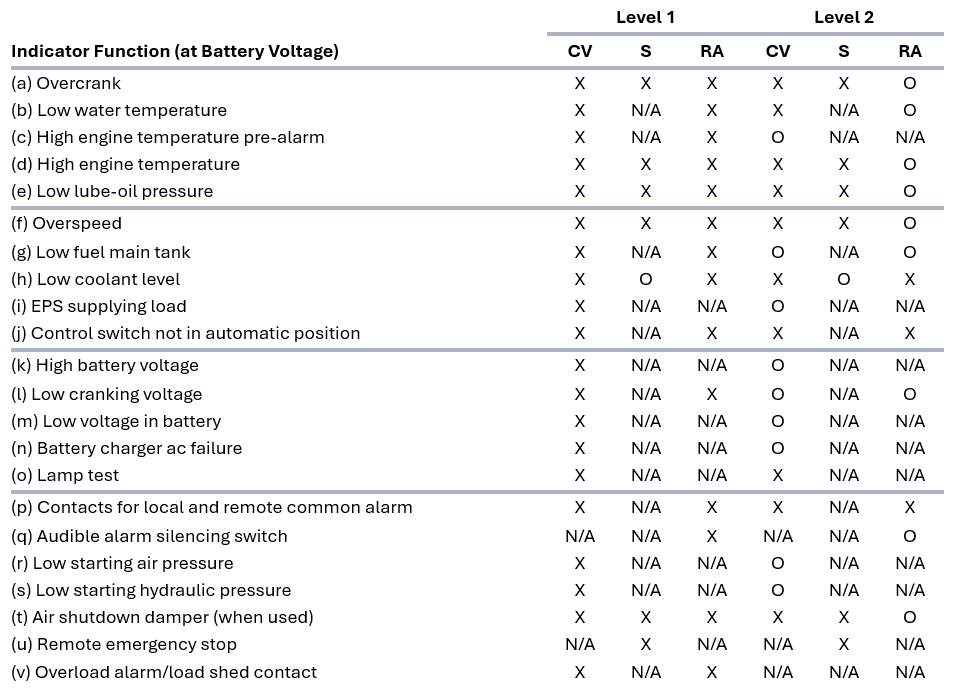
CV: Control-panel-mounted visual. S: Shutdown of EPS. RA: Remote audible. X: Required. O: Optional. N/A: Not applicable.
Notes:
(1) Item (p) shall be provided, but a separate remote audible signal shall not be required when the regular work site mentioned in 5.6.6 is staffed 24 hours a day.
(2) Item (b) shall not be required for combustion turbines.
(3) Item (r) or (s) shall apply only where used as a starting method.
(4) For the function of item (i), an EPS ac ammeter shall be permitted.
(5) All required CV functions shall be visually annunciated by a remote, common visual indicator.
(6) All required functions indicated in the RA column shall be annunciated by a remote, common audible alarm as required in 5.6.5.2(4).
(7) Item (g) on gaseous systems shall require a low gas pressure alarm. (8) Item (b) shall be set at 11┬░C (20┬░F) below the regulated temperature determined by the EPS manufacturer as required in 5.3.1.
Backup Generators - Best Practices: Maintenance
Regular maintenance is crucial for the longevity and performance of backup generators. It can help prevent mechanical failures, identify potential issues, and ensure readiness for emergencies. Trained on-site owner’s personnel, the vendor’s service organization, or an independent contractor can perform the task. Service intervals are the same for natural gas and diesel gensets. After the initial installation, conduct the required engine generator set testing.
- Factory Acceptance Test or FAT - The proof that acceptable equipment has been specified and purchased is demonstrated by testing in the factory.
- Site Acceptance Test or SAT – The proof that the equipment is acceptable at the site.
Maintenance Tasks
Once installed, perform the following maintenance tasks on a typical backup diesel generator:
- Check the oil and oil filter. Check the oil levels regularly and change the oil and filter according to the manufacturer’s recommendations.
- Check the fuel and the fuel filter. Check the fuel levels regularly and refill them as needed. Replace the fuel filter with each fuel change to prevent dirt and water from entering the engine.
- Check the battery and battery charger. Check the battery voltage and specific gravity regularly and charge it as needed. Check the battery charger for any signs of damage or corrosion, and replace it if necessary.
- Check the air filter and spark plugs. Check the air filter regularly and clean or replace it as needed. Check the spark plugs for any signs of wear or fouling, and replace them if necessary.
- Check the belts and hoses. Check the belts and hoses regularly for any signs of cracks, frays, or bulges, and replace them if necessary. Check the tension and alignment of the belts, and adjust them if needed.
- Check the coolant and radiator. Check the coolant level and quality regularly, and add or change it as needed. Check the radiator for any signs of leaks, clogs, or damage, and repair or replace it if necessary.
- Check the control panel and circuit breakers. Check the control panel regularly for any signs of damage or malfunction, and repair or replace it if necessary. Check the circuit breakers for any signs of tripping or overheating, and reset or replace them if necessary.
- Test the generator. Testing the generator helps ensure its readiness and performance. Test the generator periodically (at least monthly) under load, and monitor its output and parameters. Also, test the generator’s transfer switch and automatic start system to ensure they work properly.
Maintenance Schedule
At regular intervals, perform the following tasks (based on IEEE Std 446, Recommended Practice for Emergency and Standby Power Systems for Industrial and Commercial Applications):
- Every 25 hours of operation (or 4 months):
- Adjust fan and alternator belt
- Add oil to cup for distributor housing
- Change oil in oil-type air filter
- Drain and refill crankcase
- Clean crankcase ventilation air cleaner
- Clean dry type air cleaners
- Check transmission oil
- Check battery
- Clean external engine surface
- Perform 25-hour service (above)
- Replace oil filter element
- Check crankcase ventilator valve
- Clean crankcase inlet air cleaner
- Clean fuel filter
- Replace dry-type air cleaner
- Perform 25 and 50-hour service (above)
- Adjust distributor contact points
- Check spark plugs for fouling and proper gap
- Check timing
- Check carburetor adjustments
- Perform 25, 50, and 100-hour service (above)
- Drain and refill transmission
- Replace crankcase ventilator valve
- Replace one-piece-type fuel filter
- Check valve-tappet clearance
- Check crankcase vacuum
- Check engine compression
- Perform 25, 50, 100, and 200-hour service (above)
Backup Generators - Best Practices: Protection
- Fault Protection. Generators require protection against internal and external electrical faults and other conditions that can damage the generator and or its engine under two types of operation. The first type of operation is when the genset is operating continuously or on standby, independent of the utility line. The second is when the generator is paralleled with the utility line and is operating in order to shave or share load.
- Fire Protection. The following should be completed for diesel-fueled emergency generators:
- Safety interlocks should be provided to shut down the generators in the event of abnormal function or fire in the generator modules. The interlocks should be arranged such that any recognition of a fire will cause immediate shutdown. Automatic shutdown may be accomplished through the use of:
- A thermally actuated fire detector/device (rated at least 50┬░F (30┬░C) above the highest anticipated operating environment temperature), located directly above the generators.
- Fuel supply and return hoses should be metal braided hoses or rigid steel pipes.
- Provide an accessible and labeled manual remote shutoff for the fuel pump and safety shutoff valve in a readily accessible location under fire conditions. A designated manual fire alarm pull station may be used for this purpose with the use of dry contacts, labeling, and written procedure.
- Fuel transfer pumps should be interlocked to operate only when the generator is running.
- Fire sprinkler protection should be provided in the room (rated at least 50┬░F (30┬░C) above the highest anticipated operating environment temperature).
- Safety interlocks should be provided to shut down the generators in the event of abnormal function or fire in the generator modules. The interlocks should be arranged such that any recognition of a fire will cause immediate shutdown. Automatic shutdown may be accomplished through the use of:
Conclusion
A backup generator is an important investment for any commercial or industrial property that relies on electricity for its operations. It can provide temporary power when the main power source fails and prevent costly disruptions, losses, and risks. However, to get the most out of a backup generator, proper maintenance, operation, and protection are key.
Please contact Risk Logic Inc. if you have any further questions on generators.
References
The design and installation of generators and transfer switches are governed by several standards, including but not limited to:
https://risklogic.com/testing-and-inspection-of-emergency-generators/
NFPA 37, Standard for the Installation and Use of Stationary Combustion Engines and Gas Turbines, (NEC) Article 700, Article 701, Article 702
NFPA 70, National Electrical Code
NFPA 99, Health Care Code (for Health Care projects)
NFPA 110, Standard for Emergency and Standby Power Systems
NEMA ICS10, Industrial Control and Systems Part 1: Electromechanical AC Transfer Switch Equipment
UL 1008, Standard for Safety – Transfer Switch Equipment
IEEE 446, Recommended Practice for Emergency and Standby Power Systems for Industrial and Commercial Applications
Read more in: