Riverside County Hotel Fire Highlights Ongoing Hospitality Fire Risks
Hotel fire in Moreno Valley on February 6, 2026 highlights ongoing hospitality fire risks. Get practical takeaways from this event.
In the early hours of February 6, 2026, CAL FIRE and Riverside County Fire Department crews responded to a two-alarm fire at a hotel in Moreno Valley, California, located in the 12000 block of Day Street near the I-215 corridor. The blaze was reported shortly after 11 p.m., with flames and smoke visible from a second-floor guestroom. Firefighters advanced hose lines quickly and contained the fire to the room of origin.
Although the fire was limited to a single guestroom, smoke and water damage extended into adjacent units. Sixteen guests were evacuated and temporarily displaced. No injuries were reported, but several rooms were rendered uninhabitable pending cleanup and repairs. Investigators are still evaluating the ignition source.
The Riverside County hotel fire mirrors broader challenges within hospitality occupancies. Earlier this year, a hotel in Flint, Michigan, was closed after deficiencies were identified involving a delayed fire pump installation, and fire alarm and sprinkler system interconnection issues. Extended shutdowns were required to bring the property into compliance. These incidents reinforce that even relatively contained hotel fires can escalate into operational and financial disruptions when fire protection systems or building features are not fully optimized.
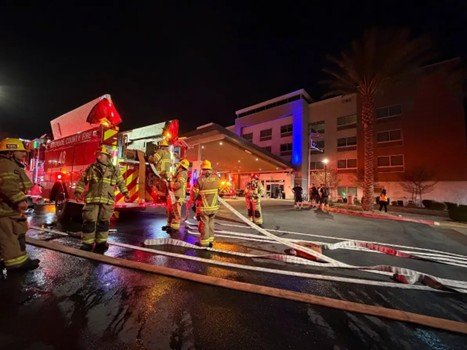 Fire crews from Riverside County Fire Department deploy hose lines outside the Moreno Valley hotel following a reported second-floor guestroom fire on February 6, 2026.
Why the Fire Spread
While the Moreno Valley fire was confined to a single room, smoke and water damage spread beyond the area of origin. In hotel occupancies, several characteristics drive loss severity:
Guestroom configuration and corridor connectivity allow smoke to migrate quickly once doors are opened during evacuation or firefighting operations. Even short-duration fires can contaminate multiple units.
Transient occupancy and late-night ignition increase the risk that a fire may grow undetected before staff intervention. Sleeping occupants rely almost entirely on automatic detection and alarm systems for life safety notification.
HVAC pathways can contribute to smoke migration if dampers or controls are not properly maintained. Smoke infiltration often drives higher restoration costs than direct flame damage.
Water application, while essential to control fire growth, frequently causes secondary damage to rooms below and adjacent to the fire floor. In multi-story hotels, suppression-related water loss can rival or exceed direct fire damage.
The cumulative effect is that a relatively small fire event can generate business interruption, guest displacement, brand impact, and regulatory scrutiny.
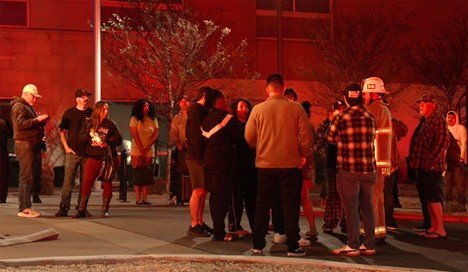 Hotel guests gather outside during late-night evacuation after smoke conditions forced displacement of multiple rooms.
For property owners, insurers, and risk managers, this Riverside County hotel fire reinforces core property protection priorities consistent with NFPA 13, NFPA 72, and FM guidance for hospitality risks.
Detection and Alarm System Readiness
Verify that guestroom smoke alarms and corridor detection are fully operational and regularly tested.
Confirm proper fire alarm panel monitoring and signal transmission to supervising stations.
Validate system interconnections, particularly after renovations or equipment upgrades.
Automatic Sprinkler Protection
Ensure complete sprinkler coverage in guestrooms, corridors, storage rooms, and concealed spaces where required.
Confirm adequate water supply, fire pump reliability, and inspection, testing, and maintenance in accordance with NFPA 25.
Review impairment management procedures to control risk during system outages.
Compartmentation and Smoke Control
Maintain fire-rated walls, floor assemblies, and corridor doors with functional self-closing devices.
Inspect smoke barriers and draft stops to limit horizontal migration.
Evaluate HVAC smoke control features and damper performance.
Maintenance and Compliance Discipline
Document corrective actions following inspections.
Avoid delayed upgrades to critical fire protection infrastructure.
Align capital planning with code compliance and insurer engineering recommendations.
Hospitality portfolios with recurring deficiencies often experience amplified loss outcomes and longer recovery timelines.
Practical Takeaways
Integrate hotel fire scenarios into property risk surveys, emphasizing detection, sprinkler coverage, and compartmentation integrity.
Conduct periodic third-party fire protection system audits to verify compliance and operational readiness.
Review housekeeping, electrical safety, and in-room appliance controls as part of ignition prevention strategies.
Strengthen impairment management protocols and ensure rapid escalation procedures during system downtime.
Coordinate pre-incident planning with local fire departments to improve response efficiency and familiarity with building layouts.
Hospitality properties operate in a high-exposure environment driven by sleeping occupants, complex layouts, and continuous turnover. Small control gaps can translate into significant operational disruption.
Risk Logic engineers help facilities identify fire hazards and implement tailored loss prevention strategies. Contact Risk Logic to evaluate your hospitality portfolio and strengthen fire protection performance.
Bottom Line: Even a single-room hotel fire can trigger widespread smoke damage and business interruption, making disciplined fire protection system management essential to controlling property loss in hospitality occupancies.