Fire Risk and Loss Prevention Lessons from the Holdingford Feed Mill Destruction
A Holdingford Feed Mill fire destroyed a 130-year-old landmark in 2026. Learn about combustible dust risks and critical fire loss prevention.
A historic feed mill fire in Holdingford, Minnesota, resulted in a total loss of the 130-year-old Holdingford Feed Mill on the evening of February 15, 2026. Emergency dispatchers received multiple reports of flames and explosions at the Stearns County facility, prompting a large-scale response from at least nine fire departments. Crews battled the blaze through the night as fire consumed the main mill structure.
By the following morning, officials confirmed the building was fully destroyed. No injuries were reported, and the facility was unoccupied at the time of ignition. Established in 1895 and owned by a local family since 2016, the mill supplied custom animal feed and agricultural products to dairy and beef operations throughout the region. While nearby grain storage bins reportedly remained standing, the core processing infrastructure was lost, creating an immediate operational disruption for area producers.
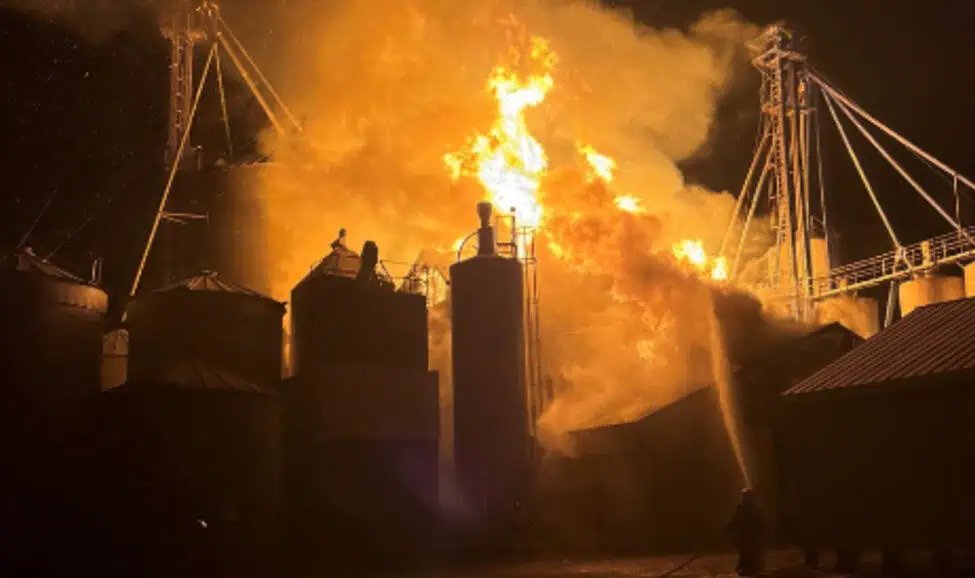 Fire engulfs the Holdingford Feed Mill on February 15, 2026, as flames extend above adjacent grain storage bins during overnight suppression operations.
Why the Fire Spread
Several structural and operational characteristics likely contributed to the severity of this historic mill fire in Holdingford, MN.
First, legacy construction presents inherent fire risk. A 130-year-old industrial structure often includes concealed void spaces, combustible framing members, and limited fire-resistive compartmentalization. Without modern fire barriers, flames can move rapidly through wall cavities, floor assemblies, and roof structures before manual firefighting efforts can gain control.
Second, feed mills operate in combustible dust environments. Grain handling and processing generate fine organic dust particles. When suspended in air and exposed to an ignition source such as overheated bearings, electrical faults, or friction sparks, grain dust can ignite and intensify fire growth. NFPA 61, Standard for the Prevention of Fires and Dust Explosions in Agricultural and Food Processing Facilities, specifically addresses these hazards because fire spread in such occupancies can escalate quickly.
Third, traditional mill design compounds the risk. Vertical bucket elevators, conveyors, and interconnected production spaces create pathways that allow heat and flame to travel between levels. These vertical shafts can function like chimneys, accelerating fire extension throughout the structure.
While official details regarding fire protection systems have not been released, many historic agricultural facilities operate without modern automatic sprinkler systems designed in accordance with NFPA 13 or FM Global Data Sheets. In unsprinklered combustible construction, once fire growth exceeds the incipient stage, total structural loss becomes increasingly probable. The sustained, multi-department response suggests extended burn duration and high heat release rates.
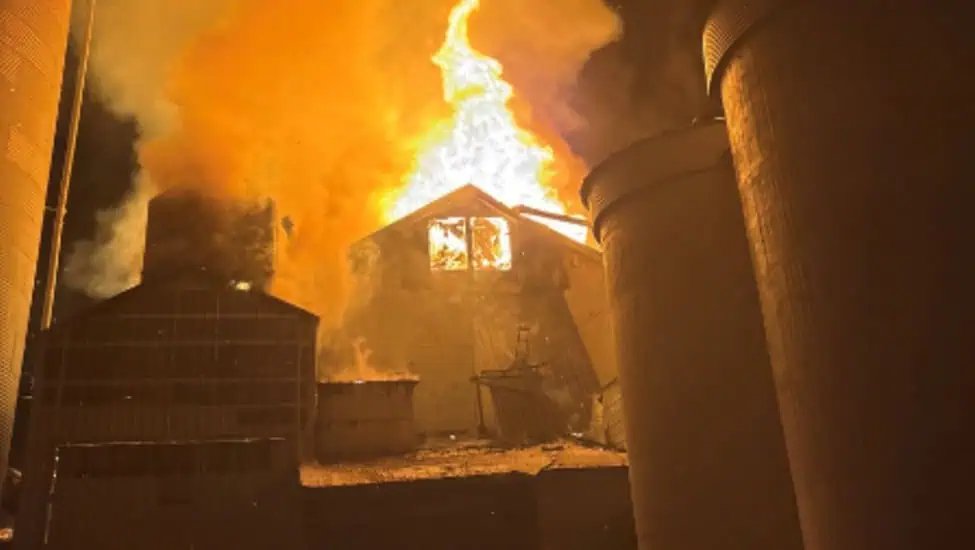 Intense flame spread through the mill’s upper processing areas highlights the vulnerability of legacy agricultural construction.
Implications for Property Loss Prevention
The destruction of the Holdingford Feed Mill highlights several critical exposures for property owners, insurers, and risk managers.
From a valuation standpoint, historic agricultural buildings often combine original construction with decades of incremental upgrades. Rebuilding today would likely trigger compliance with current building and fire codes, increasing reconstruction costs beyond the structure’s historical insured value. Accurate replacement cost valuation is essential to avoid underinsurance.
Equipment loss exposure is also significant. Feed processing operations rely on specialized conveyors, mixers, grinding systems, motors, and electrical controls. In older facilities, some machinery may be obsolete, requiring custom fabrication or modern equivalents. This extends replacement timelines and increases claim severity.
Business interruption exposure may ultimately rival the physical damage. The loss of core processing capability halts revenue generation immediately. Seasonal demand cycles, livestock production schedules, and customer contracts complicate recovery projections. In tightly integrated agricultural supply chains, downtime can have ripple effects, potentially triggering contingent business interruption exposures.
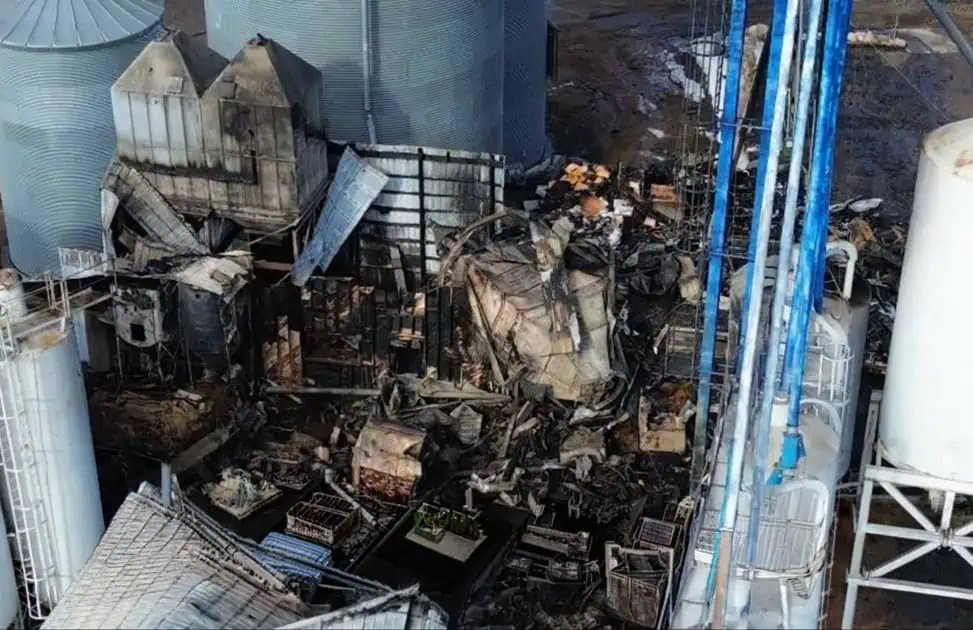 Close-up of damaged processing equipment and collapsed structural elements underscores the severity of equipment and business interruption exposure.
Practical Takeaways
Facilities operating feed mills, grain elevators, or similar agricultural processing operations should consider the following risk controls:
Install and maintain automatic sprinkler systems in accordance with NFPA 13 or applicable FM Global guidance.
Implement combustible dust management programs aligned with NFPA 61, including routine housekeeping and dust collection maintenance.
Conduct infrared thermography and preventive maintenance on motors, bearings, and electrical systems to reduce ignition sources.
Evaluate vertical conveyors and shafts for fire detection, spark detection, and explosion isolation where applicable.
Review insured values for buildings and equipment to confirm alignment with realistic replacement cost and code upgrade exposure.
Develop and test business continuity plans that address alternate production arrangements and supply chain dependencies.
Risk assessments should not be limited to structural hazards alone. Operational practices, maintenance protocols, and protection system reliability determine whether a fire event remains localized or becomes catastrophic.
For organizations operating agricultural processing facilities, proactive engineering reviews can materially reduce loss potential. Risk Logic engineers help facilities identify fire hazards and implement tailored loss prevention strategies. Contact to discuss site-specific exposures.
Bottom Line: Historic agricultural facilities with combustible dust hazards and limited fire protection face a heightened risk of total loss unless modern suppression and dust control measure