Navigating Flue Space Requirements: NFPA 13 vs. FM Updates
Stay ahead of the Flue Space Requirements Updates from NFPA 13 and FM to ensure your fire protection systems remain effective. This guide explores the latest standard changes and provides practical, engineered solutions for maintaining critical vertical venting in your rack storage.
Significant updates to flue space requirements in storage racks have occurred since our previous articles (Flue Spaces and Flue Space Requirements - NFPA vs. FM ) on the subject, as well as in the available alternatives for maintaining adequate flue spaces. Our earlier articles define the differing types of flue spaces and the ramifications of not providing them in rack storage arrangements.
As a review, flue spaces are necessary in single-, double-, and multiple-row racks to allow heat from a fire to quickly vent vertically. This is critical to help ensure that the ceiling-level sprinklers operate as quickly as possible. When flue spaces are blocked, this leads to greater horizontal fire spread within the rack, thus increasing the fire area. Flue spaces are also necessary to allow sprinkler water penetration down through the racks. This is extremely important when ceiling-only automatic sprinkler protection is provided. Without sufficient water penetration to burning commodities stored on the lower tiers of the racks, fire suppression and/or control may not be achieved, and extensive fire damage could result.
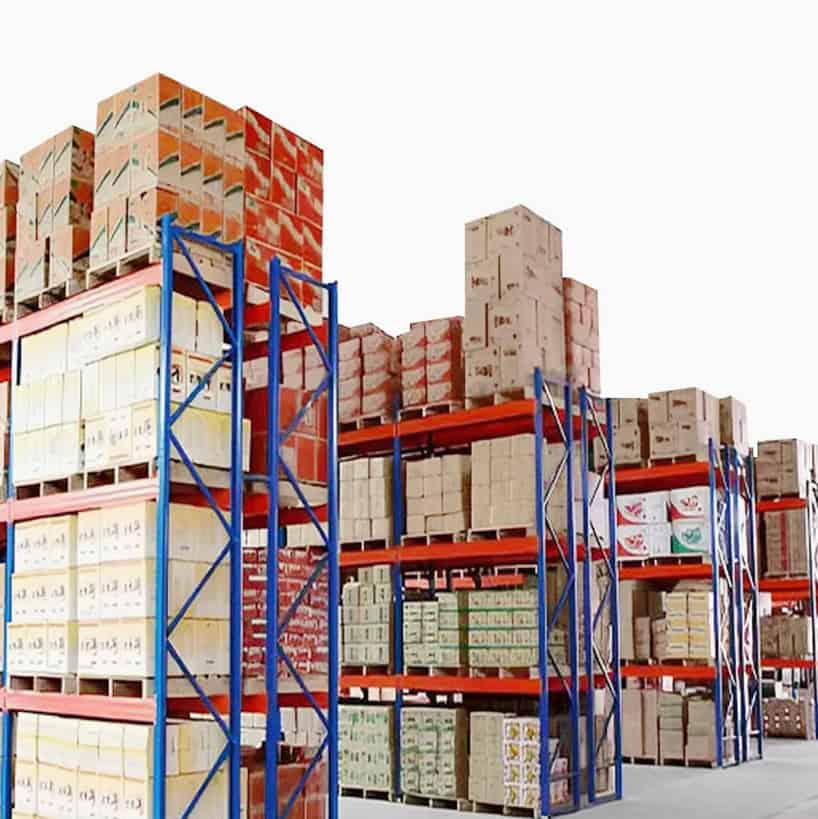
Properly maintained flue spaces are critical in high rack storage arrays, allowing heat to vent vertically and early suppression fast response (ESFR) sprinkler water to reach burning commodities.
Fire sprinkler technology has continued to advance (i.e., larger orifice Storage or ESFR sprinklers) in the last 10 years, reducing the need for in-rack automatic sprinklers (IRAS) in storage racks in buildings as high as 55 ft. (wet pipe systems with K28.0 or K33.6 pendent quick-response, standard coverage, pendent Storage or ESFR sprinklers; see Table 17b in FM Data Sheet 8-9, Storage of Class 1, 2, 3, 4 and Plastic Commodities, for other conditions/requirements). When ceiling-only automatic sprinkler protection is provided in buildings this high, it becomes even more important to maintain adequate flue spaces in racks.
Both NFPA and FM recognize the importance of flue spaces and have addressed this in their respective rack storage standards for many years. Below are some highlights and changes in the current editions of the applicable standards.
NFPA 13, Standard for the Installation of Sprinkler Systems (2025 edition):
Longitudinal Flue Spaces (Section 20.6.2.1)
Double-row Open Racks:
There have been no changes in the requirements for longitudinal flue spaces in double-row racks with Class I through Class IV and Group A plastic commodities. Longitudinal flue spaces are not required for rack storage up to and including 25 ft (7.6 m). For storage over 25 ft., a nominal 6 in. (150 mm) longitudinal flue space shall be provided for storage over 25 ft (7.6 m).
Multiple-row Open Racks:
New guidance (Section 20.6.2.1.3) was provided in the 2025 edition of NFPA 13 for longitudinal flue spaces in multiple-row racks.
Longitudinal flue spaces are not required when all the following are met:
Minimum nominal 6 in. (150 mm) wide transverse flue spaces are provided on maximum 5 ft (1.5 m) intervals.
The rack depth does not exceed 20 ft (6.1 m).
The minimum aisle width is 3.5 ft (1.1 m).
This new requirement is tied to the updated “open/solid shelving” guidance for multiple-row racks provided in the 2022 edition. If any of the above conditions are not met, then the racks are considered to have solid shelves, and IRAS will likely be required.
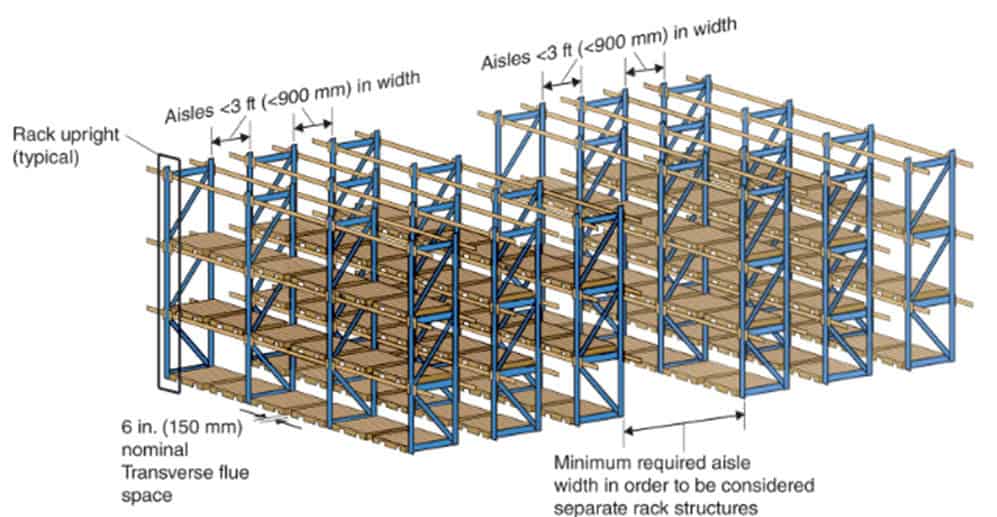
A diagram illustrating transverse flue spaces (the space between loads side-by-side) and multiple-row racks.
Transverse Flue Spaces (Section 20.6.2.2)
There have been no changes in the requirements for transverse flue spaces in single-, double-, and multiple-row racks. The section guidance is as follows: Nominal 6 in. (150 mm) transverse flue spaces between loads and at rack uprights shall be maintained in single-, double-, and multiple-row racks.
NFPA 13 still permits random variations in flue space width or vertical alignment. This is supported by full-scale fire test data detailed in Annex C (C.26), which proved that flue openings must be continuous from the top to the bottom of the racks, but they do not need to be perfectly aligned. It is, however, still recommended to maintain consistent flue space width and alignment as best as possible.
The required width of the flue is designated as a nominal dimension by NFPA 13 rather than a hard minimum. That allows variation in the available clear width of the flue space to accommodate common items, such as in-rack sprinkler piping, rack upright members, and so forth. Annex C (C.13) still indicates that fire test results indicate flue spaces of about 3 in. (75 mm) allow reasonable passage of sprinkler water down through racks.
FM Property Loss Prevention Data Sheet 8-9, Storage of Class 1, 2, 3, 4 and Plastic Commodities (July 2025 edition):
FM made significant changes to its flue space guidance in the July 2020 and July 2021 editions and then made additional updates in January 2022.
Double-row Open-frame Racks:
Prior to 2021, FM had not required longitudinal flue spaces in double-row racks to any height; however, if they were provided, they recommended maintaining a minimum net width of 3 in. (75 mm) throughout the vertical height of the rack. Current FM guidance for double-row racks provides two options for required flue widths and spacing, depending on whether the flue spaces are misaligned.
2.2.3.2.3.2 Flue spaces for double-row racks are considered adequate when:
Racks void of any misaligned flue spaces throughout the entire height of the rack have a minimum 3 in. (75 mm) net wide longitudinal flue spaces and minimum 3 in. (75 mm) net wide transverse flue spaces, a maximum of every 4½ ft (1.4 m), as indicated in Figure 2d, or
Racks void of any misaligned flue spaces throughout the entire height of the rack have minimum 3 in. (75 mm) net wide longitudinal flue spaces and minimum 6 in. (150 mm) net wide transverse flue spaces a maximum of every 9 ft (2.7 m), as indicated in Figure 2e, or
Racks void of any misaligned transverse flue spaces throughout the entire height of the rack, but with longitudinal flue spaces less than 3 in. (75 mm) net wide, have minimum 6 in. (150 mm) net wide vertically aligned transverse flue spaces a maximum of every 5 ft (1.5 m), as indicated in Figure 2f, or
Racks with misaligned transverse flue spaces have a minimum of 3 in. (75 mm) net wide longitudinal flue spaces and a minimum of 6 in. (150 mm) net wide vertically aligned transverse flue spaces, a maximum of every 4½ ft (1.4 m), as indicated in Figure 2g.
Case B above allows for the greatest distance (up to 9 ft. (2.7m)) between transverse flue spaces in single- and double-row racks (with a minimum 3 in. (75 mm) net wide longitudinal flue space) as depicted in the figure 2e below.
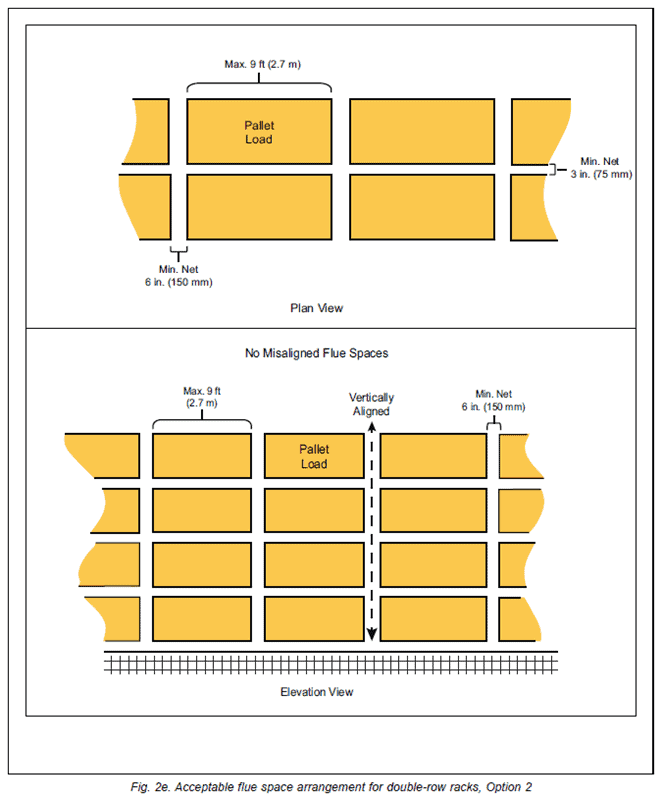
Assuming there are random variations in the width of flue spaces or in their vertical alignment, the two standards have similar requirements for racks over 25 ft. high.
Standard | Longitudinal Flues | Transverse Flues | ||
SR Racks | DR Racks | SR Racks | DR Racks | |
NFPA 13 (2025) | N/A | Nominal 6 in. (150 mm) flues required only if storage > 25 ft. | Nominal 6 in. (150 mm) flues required between loads and at rack uprights | |
FM DS 8-9 (7/25) | N/A | Minimum 3 in. (75 mm) wide required in all racks | Minimum 6 in. (150 mm) net wide flue spaces every 4½ ft (1.4 m) maximum. | |
Multiple-row Open Racks:
Prior to July 2020, FM recommended net 6 in. (150 mm) wide longitudinal flue spaces within multiple-row racks a maximum of every 16 ft (4.8 m) horizontally. Since then, this guidance changed significantly. Current guidance (July 2025) is as follows:
2.2.3.2.4.2 Flue spaces for multiple-row racks are considered adequate when:
Racks void of any misaligned flue spaces throughout the entire height of the rack have minimum 6 in. (150 mm) wide longitudinal flue spaces a maximum of every 5 ft (1.5 m) as well as minimum 6 in. (150 mm) net wide transverse flue spaces a maximum of every 5 ft (1.5 m), as indicated in Figure 2h, or
Racks are limited to a maximum depth of 20 ft (6.1 m), as defined by a minimum 8 ft (2.4 m) wide aisle, and have minimum 6 in. (150 ) net wide transverse flue spaces a maximum of every 5 ft (1.5 m), as indicated in Figure 2i.
Flue space guidance for multiple-row racks is consistent between the two standards with the minimum aisle width requirement (NFPA 13 requires 3.5 ft vs. FMDS 8-9 requires 8 ft) being the one significant exception.
In summary, the two standards are similar, but are not yet the same.
Required flue widths and the definitions thereof remain different.
Both standards now allow for misaligned flue spaces.
FM requires a greater aisle width between multiple-row racks.
Recommended transverse flue spacing can vary between both, and then there is the use of the term “between loads” vs. the specific spacing in ft (m).
Another crucial factor in maintaining flue spaces is understanding your pallet dimensions. American pallets (commonly known as GMA pallets) are 48 x 40 in. (1219 x 1016 mm) while European pallets (EUR pallets) are 47.2 x 31.5 in (1200 x 800 mm). Although the pallet widths are essentially the same, the GMA pallets are 8.5 in. deeper. In racks containing both pallet types, this can lead to blocking longitudinal flues (if pallets overhang the rear of the rack) or a personnel safety hazard (if pallets overhang the face of the rack) if the racking was not designed for the pallets in use.
What to do if you’re having trouble maintaining the required minimum flue spaces in your storage racks?
Both standards treat storage racks that lack adequate flue spaces, as described above, as racks with solid shelves. There are different options that can be pursued, and these options can entail high costs and difficulty in accomplishing. In addition, the provision of some options can introduce new property loss exposures (E.g., lift truck drivers hitting IRAS).
Some examples of efforts to maintain flue spaces in open-frame storage racks include:
Administrative & System Controls:
Installation of IRAS: When racks are protected by In-Rack Automatic Sprinklers, flue spaces are not required for the tier level located directly above the IRAS.
Visual Indicators: Apply reflective tape or customized stickers on rack horizontal members noting required flue space locations and widths.
Physical Barriers & Engineered Solutions:
Custom Physical Barriers: Use small-diameter PVC pipe pieces, cables, or wood blocks attached to the racks as a physical barrier.
Transverse Flue Spacers: Products like FlueKeepers® and Pallet Rack U-Dividers are steel rods bolted to the uprights to 'block off' a 3 in. or 6 in. space. (Note: Some municipalities now require such devices during the High Piled Storage Permit application process).
Load Stop Beams & Flue Guards: Available from suppliers like ULINE and Rack Safety Products, these prohibit pallets from being pushed too far over the back beam, avoiding longitudinal obstructions.
Vertical Barriers: Sheet metal or plywood attached to the end of each rack bay, extending through the entire rack height. Fire modeling indicates these barriers limit horizontal fire spread, allowing ceiling sprinklers to suppress the fire.
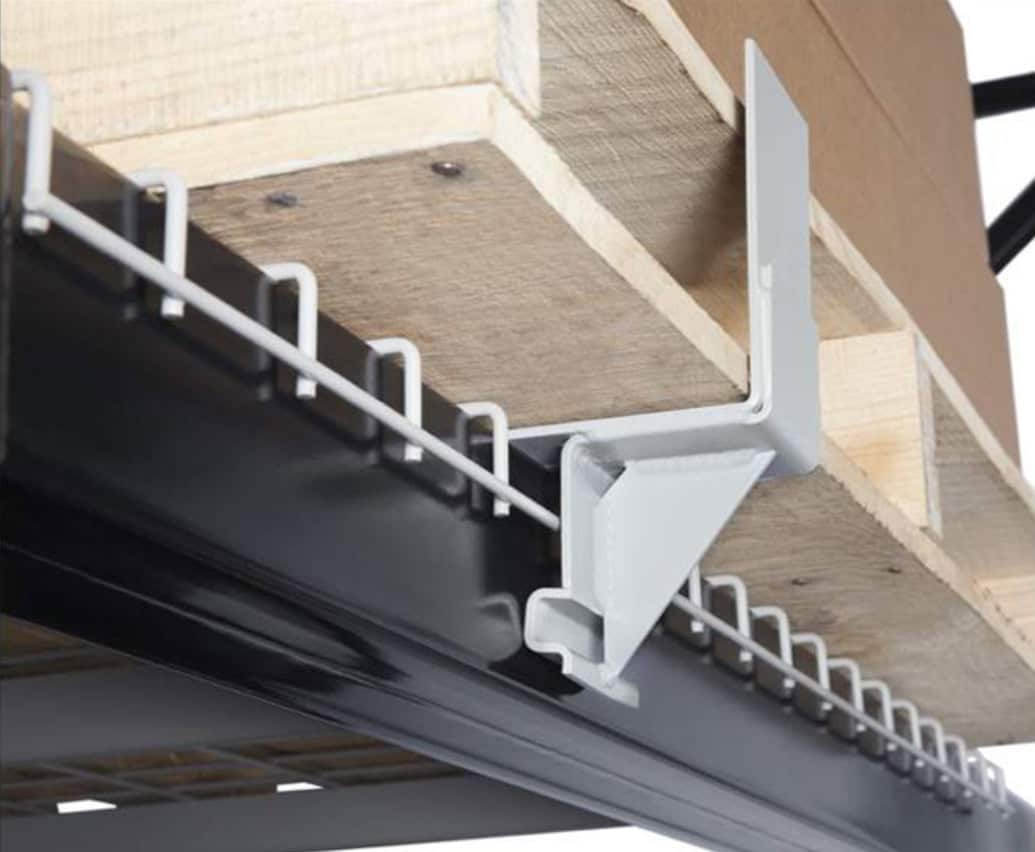
Engineered solutions, such as flue guards attached to the rack uprights, physically prevent pallets from being pushed too far back, ensuring the longitudinal flue space remains unobstructed.
There are pros and cons for each option above, and not all options will work for your facility.
Risk Logic can help you ensure that adequate flue spaces are provided for the rack storage at your facility. Please contact us for more details.