The Importance of Real-Time Notifications and Risk Management Tools - Risk Management Information System (RMIS)
October 2025 – Update from the August 2023 article Executive Summary Risk Management Information System (RMIS) platforms do a lot more than store data these days. They notify you immediately when...
October 2025 – Update from the August 2023 article
Executive Summary
Risk Management Information System (RMIS) platforms do a lot more than store data these days. They notify you immediately when risks pop up, show how your risk scores stack up against competitors, and track the recommendations you're working on. Our RMIS helps you get ahead of problems instead of chasing them after they've already cost you money.

Why Modern Risk Management Needs RMIS
Risk Management Information System platforms have become essential tools for monitoring exposures, reducing losses, and strengthening overall resilience. Our system goes beyond collecting information; it helps you understand what that information means for your business.
With centralized access to data, real-time reporting, and actionable insights, RMIS platforms enable more efficient risk management and enhance underwriting decisions. When you can access current information instantly, you can respond to risks before they become expensive problems. Risk & Insurance found that companies are utilizing RMIS platforms for Claims 82% of the time, but is seeing an increase in other areas such as Policy Management (up 29%) and Exposure Tracking (up 19%). Risk&Insurance
This approach establishes a solid foundation for business growth while maintaining smooth operations, even in the face of complex risks.
Real-Time Impairment Notifications: Your Early Warning System
The implementation of real-time impairment notifications serves as a critical early warning system, equipping stakeholders with the ability to respond promptly to identified risks and minimize potential disruptions and losses. Impairments encompass a broad spectrum of issues, including fire protection equipment failures and planned outages that, if left unmanaged, could escalate into costly incidents.
The system automatically sends alerts to the right people the moment an impairment is reported. No more waiting for someone to send an email or for the next loss prevention survey. You gain instant awareness, which means you can actually take action on problems instead of just cleaning up the mess afterward.
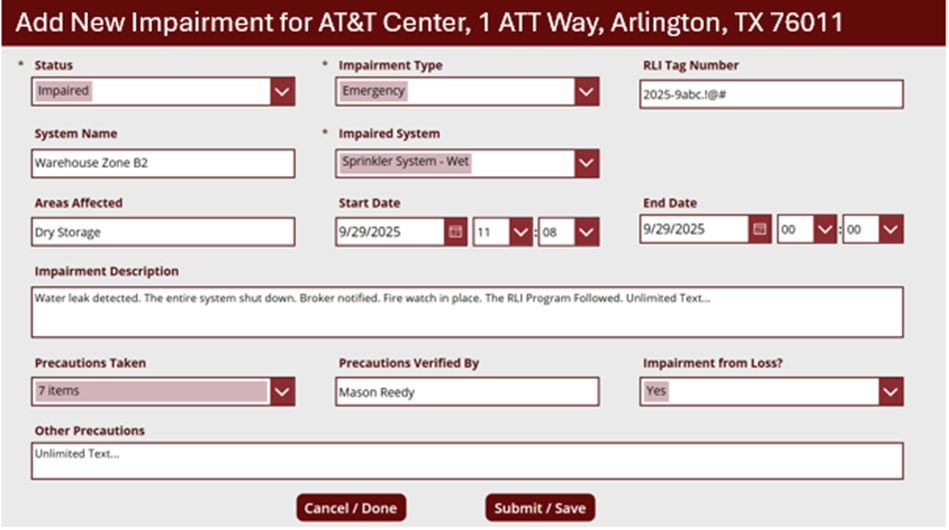
Mobile capability makes this even more powerful. Your field team can get alerts on their phones, confirm they've seen them, and start fixing problems right where they are. It creates a direct path from "we have a problem" to "we're handling it."
Risk Improvement Recommendations: Building Long-Term Resilience
While real-time impairment notifications ensure organizations can react immediately to emerging risks, long-term resilience depends on how effectively they address and implement recommendations for systematic improvement. Our Risk Management Information System centralizes risk improvement items, assigns them to responsible individuals, and tracks progress toward completion.
Risk improvement recommendations serve multiple strategic purposes: they identify potential hazards and financial exposures while providing specific steps for addressing them. As organizations implement these recommendations, they experience fewer incidents, less property damage, and fewer business interruptions.

The focus is on protecting people and assets through proven risk reduction methods. From a business perspective, addressing these recommendations typically reduces both the frequency and severity of claims, which positively impacts insurance underwriting decisions and can result in premium reductions over time.
The platform's tracking features ensure accountability and provide concrete evidence that your risk management program is working. This documentation proves valuable for insurance renewals and reporting risk reduction to stakeholders.
Risk Assessments: Getting the Full Picture
Property insurance revolves around COPE (Construction, Occupancy, Protection, and Exposure) data, which provides insurers with essential information about properties, directly influencing coverage decisions and premium calculations. Our system streamlines the collection and verification of this data, creating detailed risk reports that support informed decision-making and insurance compliance.
The platform pulls information from multiple sources, including property inspections, historical claims, and natural catastrophe data. This approach fills in information gaps that could lead to coverage disputes or inadequate protection.
The RMIS transforms raw data into actionable insights through customizable templates and advanced analysis tools. Information stays complete, consistent, and current while eliminating data entry errors and speeding up report creation. Risk control teams can quickly identify vulnerabilities, prioritize the necessary fixes, and monitor progress over time.
This combination of accurate data collection and sophisticated reporting enables organizations to transition from merely assessing risks to actively managing them, thereby building operational strength while providing stakeholders with clear visibility into risk exposure and mitigation efforts.
Why Risk Score Benchmarking Matters
Raw risk scores tell you where you stand today, but they only become truly valuable when compared against meaningful benchmarks. Our platform provides three essential comparison frameworks: industry peer benchmarks, regional trends, and location-by-location analysis.
Industry Peer Benchmarking: How Do You Stack Up?
Where do you stand compared to others in your industry? Our benchmarking draws from thousands of surveys since 1997, so you get reliable comparisons that reflect real performance across different economic cycles.
Take a seafood processing plant with a risk score of 70. That's above average; the industry typically sits around 64. But the same score at a hospital? There's work to do, since healthcare facilities average 85. Context matters.
These comparisons help you make smarter decisions about where to spend money on improvements, provide leverage when negotiating insurance rates, and enable you to learn from companies that are doing things right. Instead of setting random improvement goals, you can aim for realistic targets based on what's actually achievable in your industry.
Tracking Progress Over Time
Historical benchmarking shows how your program is trending. A manufacturer, for instance, might see scores rise from 68 to 75 in two years; tangible proof that safety initiatives are paying off. This data helps forecast future performance, validate strategies, and justify budgets.
Regional and Location-Based Insights: Understanding Where Risks Concentrate
Regional and site-level benchmarking reveal how geography and local conditions affect your overall risk profile. The platform analyzes patterns across different regions and facilities to highlight where exposures are highest and why.
When you compare performance across multiple locations, you can identify top-performing sites and share their best practices across your organization. Likewise, locations with lower risk scores can be prioritized for investment and improvement. This approach drives smarter resource allocation, improves overall program performance, and ensures that every site contributes to reducing total organizational risk.

Ultimately, combining regional and location-based benchmarking turns data into actionable direction, showing how to manage risks more effectively across your entire portfolio.
Making Strategic Decisions with Real Data
All this benchmarking pays off when making big decisions. When a food processing company was considering acquiring a competitor, it used our benchmarking to evaluate the target facilities. They discovered two plants were significantly below industry averages for safety risks, which helped them develop an integration plan focused on bringing those facilities up to standard.
The same data also aids in insurance negotiations. Companies with risk scores better than their peers have concrete evidence to push for lower premiums. When presenting to the board or investors, you can demonstrate measurable progress with hard numbers instead of just discussing "improved safety culture."
Data Management and Security: Protecting What Matters
Data security is a major concern when implementing Risk Management Information System platforms. These systems handle sensitive information about risk assessments, insurance policies, claims, and business operations, so strong security measures are essential throughout the platform.
Real-time capabilities introduce potential vulnerabilities that require solid security protocols. Organizations need advanced encryption, multi-factor authentication, role-based access controls, and continuous monitoring to protect data from unauthorized access, breaches, and cyberattacks.
To maintain data integrity and confidentiality, organizations should conduct regular security audits, train employees on cybersecurity best practices, and keep RMIS software current with the latest security updates. These measures build trust with clients, business partners, and regulators while protecting organizational reputation and credibility.
Implementation Support and Training Resources
Risk Logic provides implementation support through detailed video tutorials and training materials designed to maximize platform utilization:
- Data Analytics, Data Mining and Drill Down Functions: Advanced techniques for extracting actionable insights from comprehensive risk databases
- Mobile Recommendation Completion with Updates: Field-based tools for real-time risk mitigation and progress reporting
- Plant Manager Online Functions and Impairments: Facility-level risk management capabilities
The Future of Strategic Risk Management
Modern Risk Management Information System platforms represent a major shift in how organizations approach risk management. Instead of simply collecting data, they provide intelligence that drives measurable business results. Our platform combines real-time notifications, benchmarking, and analytics to create a unified risk management system.
Think of it this way: a speedometer tells you how fast you're going, but a GPS tells you where you need to turn. Most platforms provide you with a speedometer and endless data about your current state. Our system acts like a GPS, showing you exactly where to go next based on what's working for similar companies.
As businesses face evolving challenges in an increasingly complex risk environment, advanced RMIS platforms will remain essential for protecting assets, reducing losses, and driving sustainable growth. Organizations that adopt these technologies position themselves not just to manage risk more effectively, but to turn risk management into a competitive advantage.
Investment in RMIS capabilities pays off through reduced losses, better insurance terms, improved regulatory compliance, and better decision-making throughout the organization. In a business environment where effective risk management increasingly separates leaders from followers, the question isn't whether to implement advanced RMIS capabilities; it's how quickly organizations can use these tools to achieve superior risk management results.
Risk Logic offers customers highly customizable RMIS solutions tailored specifically for commercial property applications. For detailed information about our comprehensive risk management platform and to schedule a personalized demonstration, contact mreedy@risklogic.com.
Read more in: