Fire in Ocala Highlights Process Equipment Overheating and Early Detection
Early detection saves facilities. When a commercial popcorn maker overheated at an Ocala facility, automated alarms and trained staff stopped a localized fire from becoming a catastrophic property loss. Learn how integrated risk engineering protects your critical assets.
A fire at the Signature Brands facility in Ocala, Florida, on August 6, 2026, demonstrates how effective fire detection and trained employees can prevent process equipment overheating from escalating into a significant commercial property loss. Ocala Fire Rescue responded to the facility at approximately 1:05 a.m. after receiving signals from both an automated monitoring system and a manually activated pull station. Employees evacuated the building and directed arriving firefighters to the area where smoke was developing. No injuries were reported, and firefighters confirmed that the fire did not spread beyond its initial area.
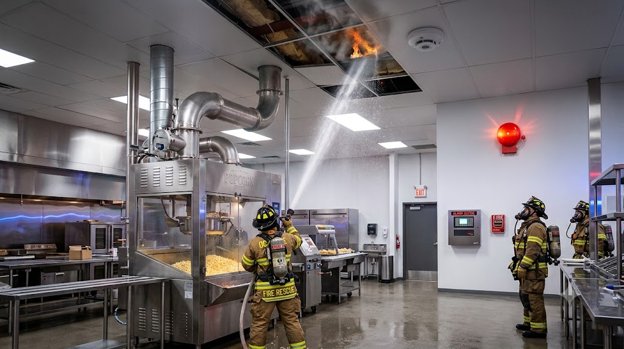 Firefighters in full protective gear battle an industrial fire inside a commercial kitchen. (Source: Generated Image)
Incident Overview & Risk Factors
According to Ocala Fire Rescue, the fire originated at a commercial popcorn maker when a pipe associated with the equipment overheated and ignited material in the ceiling area. Although firefighters observed no visible flames from outside the building, smoke had begun filling the facility. Crews removed ceiling tiles to reach the fire and used approximately 750 gallons of water to extinguish it before checking the surrounding area for remaining hot spots.
The incident highlights an important property risk associated with heated production and process equipment. Equipment surfaces, exhaust components, piping, ducts, and other heat-producing components can become ignition sources when temperatures exceed their intended operating range or combustible building materials are located too close to them. Once fire extends above a suspended ceiling or into another concealed space, detection and manual firefighting can become more difficult, increasing the potential for fire spread before conditions become visible from the exterior.
In this case, two layers of notification provided an important advantage. The automatic monitoring system transmitted an alarm, while an employee also activated a manual pull station. Ocala Fire Rescue specifically credited operational alarms and attentive employees with helping minimize damage.
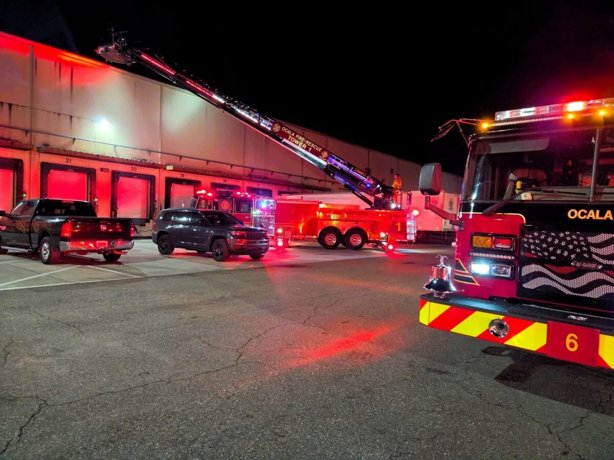 Ocala Fire Rescue crews respond to an equipment fire involving a commercial popcorn maker.
Property Loss & Insurance Implications
For property owners and insurers, the Ocala fire illustrates the value of treating production equipment as part of the facility's overall fire protection program rather than relying solely on building-level protection. Preventive maintenance programs should identify abnormal heating, degraded components, combustible deposits, impaired safety controls, and changes in equipment operation before they become ignition sources. FM Property Loss Prevention Data Sheet 9-0, Asset Integrity, provides guidance for developing inspection, testing, and maintenance programs intended to mitigate risks associated with process equipment overheating and reduce equipment-related property losses.
Fire detection is equally important. NFPA 72, National Fire Alarm and Signaling Code, addresses the installation, performance, inspection, testing, and maintenance of fire alarm and emergency communications systems used to protect life and property. The Signature Brands incident provides a practical example of why reliable alarm transmission and properly trained employees remain important layers of protection.
Facility-level controls should include:
Inspect heat-producing production equipment, piping, ducts, and exhaust components for abnormal temperatures, deterioration, or combustible deposits.
Maintain required clearances between heated equipment and combustible construction or storage.
Test temperature controls, shutdown devices, interlocks, and other equipment safeguards according to manufacturer recommendations.
Maintain automatic detection, alarm transmission, and manual pull stations in reliable operating condition.
Train employees to recognize abnormal equipment conditions, initiate alarms, evacuate promptly, and communicate the fire location to responding personnel.
Evaluate concealed spaces above process equipment to determine whether combustible construction or inadequate fire protection could permit hidden fire spread.
Risk Logic Perspective: Process Equipment Overheating
Small process-equipment fires can produce disproportionately large property losses when ignition occurs near combustible construction or extends into concealed spaces. A risk engineering assessment should evaluate not only the machinery itself, but also its relationship to ceilings, walls, utilities, ductwork, combustible deposits, storage, and automatic fire protection.
Routine inspections should verify that equipment is operating within design limits and that maintenance programs address deterioration before failure occurs. Fire alarm systems, monitoring services, emergency procedures, and employee training should also be reviewed as an integrated protection strategy to stop process equipment overheating before it threatens the entire structure. The Ocala incident shows how these layers can work together, providing early warning and allowing firefighters to intervene before a localized equipment fire develops into a major facility loss.
Risk Logic engineers help commercial and industrial facilities evaluate process hazards, fire protection systems, equipment maintenance programs, and emergency response procedures to reduce the potential for major property losses. Contact Risk Logic to learn more about property loss prevention and fire protection assessments.
Bottom Line: Early detection, vigilant employees, and effective equipment maintenance can prevent a localized process-equipment overheating event from becoming a major commercial property fire.