Lessons on Urban Commercial Fire Risk from the Downtown LA Office‑Supply Fire
A Downtown LA commercial fire reveals how combustible storage, aging structures, and dense mixed‑use exposures amplify urban commercial fire risk. This case study shows how a single building fire can escalate into a broader property and business interruption event — and what facility owners, insurers, and risk managers can do to prevent it.
On May 10, 2026, a commercial building fire in Downtown Los Angeles prompted a Major Emergency response at 1225 South Hope Street, near Pico Boulevard. The incident quickly demonstrated how urban commercial fire risk can escalate when combustible contents, aging structures, and limited access converge. The Los Angeles Fire Department reported that the fire involved a 100-by-100-foot, two-story commercial occupancy with a mezzanine operating as an office supply company. Firefighters initially entered the building to attack the fire and search for occupants, but worsening conditions, heavy roof fire, and smoke under pressure forced a transition to exterior operations.
The Downtown Los Angeles commercial fire involved approximately 124 LAFD firefighters during the initial response, with additional resources later requested, including arson investigators, heavy equipment, an Urban Search and Rescue unit, and the department’s remote-controlled firefighting robot. One firefighter was injured and transported to a local hospital. LAFD reported that the main body of fire was declared knocked down at 5:52 a.m., but crews remained on scene for extended operations due to roof collapse, hot spots, and cleanup needs.
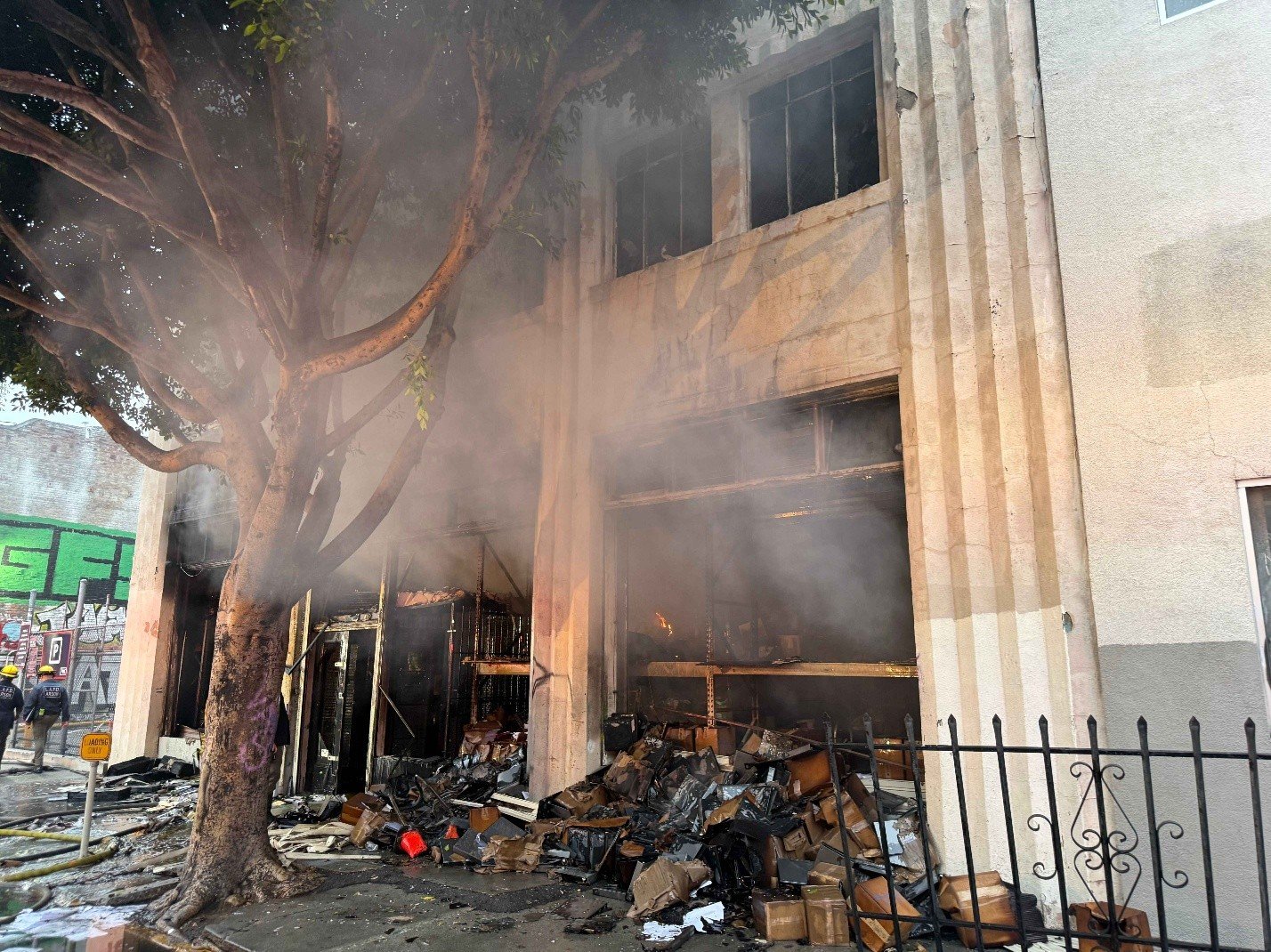 Smoke pours from the heavily damaged commercial structure as crews work to contain remaining hot spots following the Downtown Los Angeles fire.
Incident Overview & Risk Factors
Urban commercial fires can escalate quickly when combustible contents, older building features, and limited access converge. In this incident, LAFD reported heavy fire from the roof, thick smoke pushing from roll-up doors, and a roof collapse onto the second floor. Those conditions made portions of the building unsafe and inaccessible, requiring crews to continue suppression from the exterior.
Office supply occupancies can create significant fire loads because of paper products, packaging, and other stored inventory. When these materials are concentrated in retail or storage areas, they can increase heat release, smoke production, and overhaul duration.
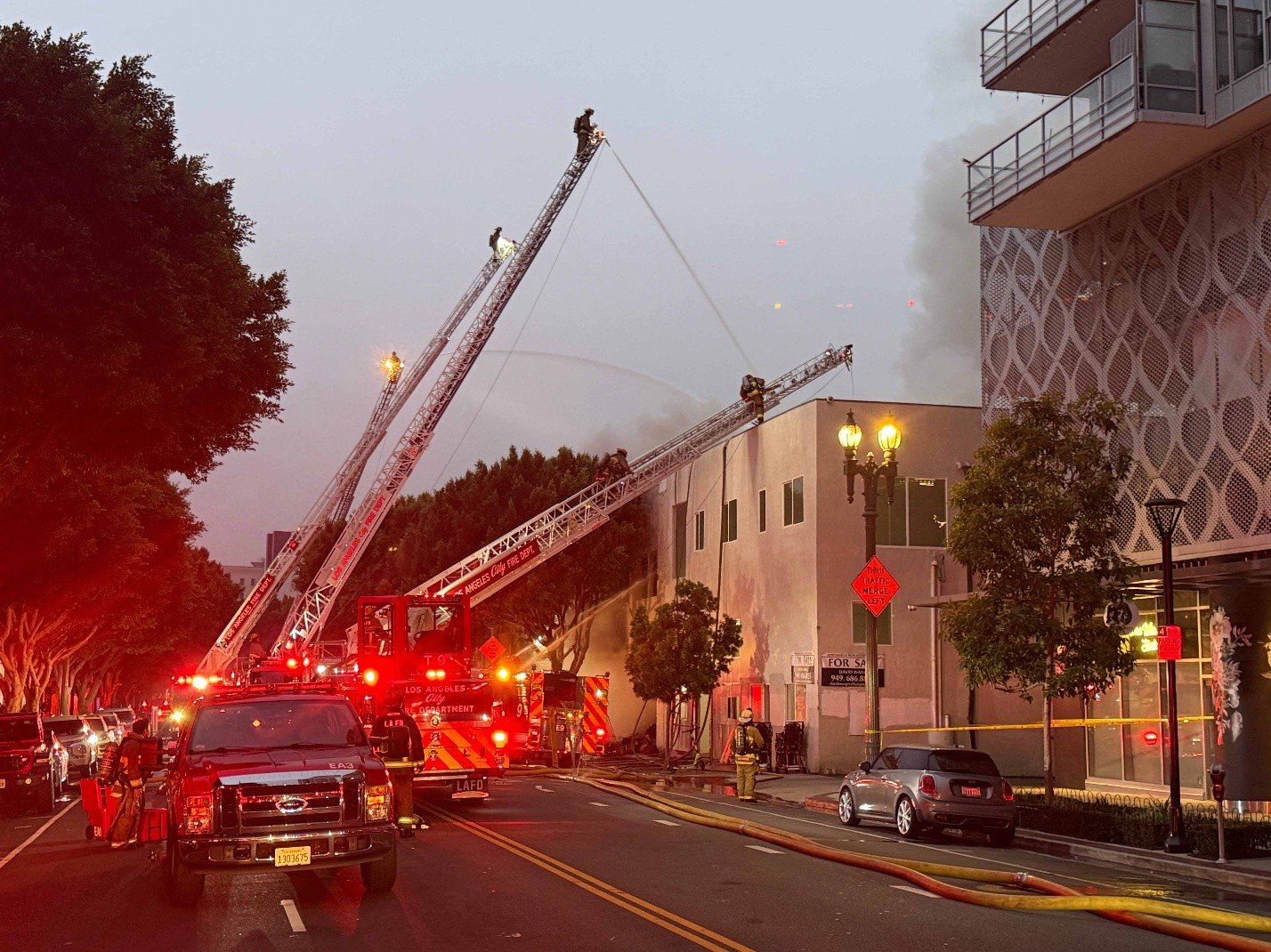 LAFD crews deploy multiple aerial master streams as firefighters battle the intense commercial structure fire in Downtown Los Angeles.
Property Loss & Insurance Implications
For insurers and property owners, the incident demonstrates how a single commercial building fire can create broader property and business interruption exposure in an urban setting. Direct fire damage may be only one part of the loss profile. Smoke migration, water damage, roof collapse, inaccessible fire areas, tenant displacement, and extended emergency operations can all affect claim severity.
Older commercial buildings should be evaluated for fire protection adequacy, electrical system condition, compartmentation, roof integrity, and storage practices. NFPA 13 remains a key benchmark for automatic sprinkler system design and installation, while NFPA 25 provides the baseline for inspection, testing, and maintenance of water-based fire protection systems. FM property loss prevention data sheets also provide engineering guidance intended to reduce property loss from fire, equipment failure, and other hazards.
Key prevention and control measures include:
Verify sprinkler protection is appropriate for the occupancy, storage arrangement, and commodity mix.
Maintain fire doors, rated walls, and tenant separations to limit fire and smoke spread.
Inspect electrical system, especially in older commercial buildings with changing tenant operations.
Control combustible storage, aisle spacing, and housekeeping in retail and back-of-house areas.
Maintain clear fire department access, hydrant access, and pre-incident response information.
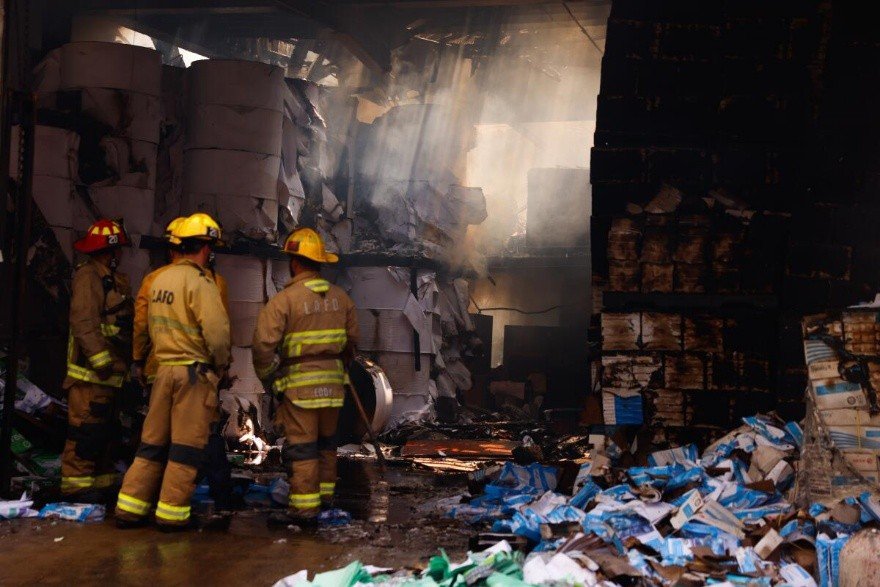 Crews investigate hot spots in a fire fed by office supplies.
Risk Logic Perspective: Urban Commercial Fire Risk
Dense commercial districts require more than code-minimum awareness. Facility owners and risk managers should treat neighboring exposures, shared walls, roof configurations, utility chases, and storage practices as part of the total fire risk profile. A fire that begins in one tenant space can become a multi-property exposure event when fire protection, compartmentation, or access conditions are inadequate.
Periodic risk assessments should focus on occupancy changes, fire protection system reliability, electrical maintenance, roof and structural condition, and combustible loading. Pre-fire planning with local fire officials can also improve response coordination, especially in buildings with concealed spaces, roll-up doors, mezzanines, or limited apparatus access.
Risk Logic engineers help facilities identify fire hazards and implement tailored loss prevention strategies. Contact Risk Logic to evaluate fire protection programs, storage arrangements, and property loss prevention opportunities.
Bottom Line: The Downtown Los Angeles commercial fire shows how combustible storage, aging urban buildings, and dense exposures can turn one structure fire into a significant property and business interruption risk.
Photo Credit: LAFD Captain II Cody Weireter