Warehouse Fire Protection Reliability: Lessons from the Tracy, CA Facility Fire
The total destruction of a 1-million-square-foot Medline facility in Tracy, CA highlights a catastrophic threat for commercial properties: when private water systems fail, municipal response alone cannot stop a developing blaze. Discover the critical lessons this disaster teaches about warehouse fire protection reliability, NFPA compliance, and safeguarding your supply chain from total loss.
On June 11, 2026, a medical supply warehouse fire destroyed Medline’s approximately 1 million-square-foot distribution facility at 5701 Promontory Parkway in Tracy, California. Fire crews responded around 1:00 p.m. to reports of a roof fire, and the City of Tracy reported that early suppression efforts were hampered by a failure of the building’s private fire water system. The catastrophic loss of the entire facility underscores critical gaps in warehouse fire protection reliability, creating significant smoke and debris concerns for the surrounding area while triggering evacuations at nearby commercial properties.
No injuries were reported, and Medline employees and on-site personnel were accounted for. Fire officials reported that the facility’s sprinklers and on-site hydrants were not delivering water as expected, forcing crews to rely on municipal water sources outside the property. The cause of the fire and the apparent failure of the fire protection system remain under investigation.
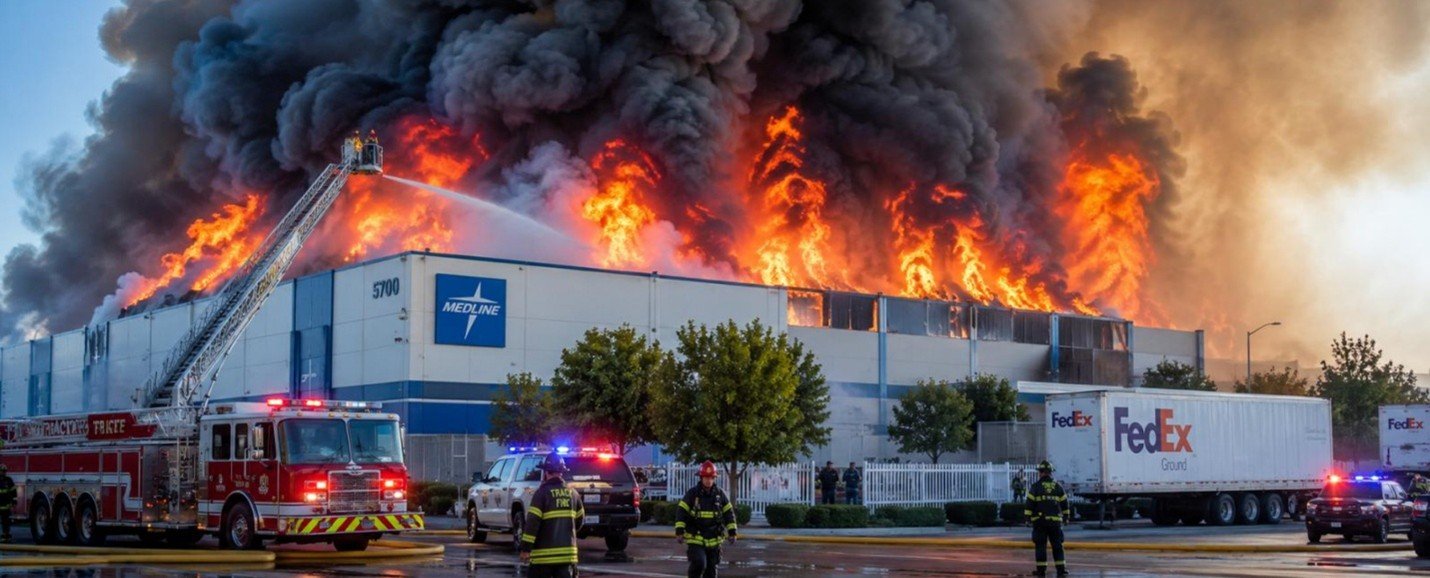 Low water pressure and limited on-site water supply reportedly hampered firefighting efforts, allowing the warehouse fire to grow rapidly and complicating suppression operations.
Incident Overview & Risk Factors
The Tracy medical supply warehouse fire demonstrates how quickly a large storage occupancy can become indefensible when fire protection infrastructure does not perform. According to city officials, high winds, low humidity, elevated temperatures, and the private fire water system failure allowed the fire to extend rapidly into the building. Fire officials also reported that the warehouse became fully consumed within a short period, shifting the response toward defensive operations.
Large distribution centers contain dense fuel loads, extensive rack storage, packaging materials, material handling equipment, and long travel distances for manual firefighting. These conditions make automatic sprinkler performance, fire pump reliability, valve supervision, and on-site water supply critical to limiting fire growth. When these systems are impaired or unable to deliver adequate water, municipal response alone may not be able to control a developing warehouse fire before major property loss occurs.
The event also involved potential exposure hazards beyond the building footprint. San Joaquin County officials warned residents about black smoke and ongoing air quality monitoring, while local reporting noted that fire officials were reviewing hazardous materials and lithium-ion battery exposures inside the facility. These conditions can complicate fire operations, debris cleanup, environmental controls, and recovery planning.
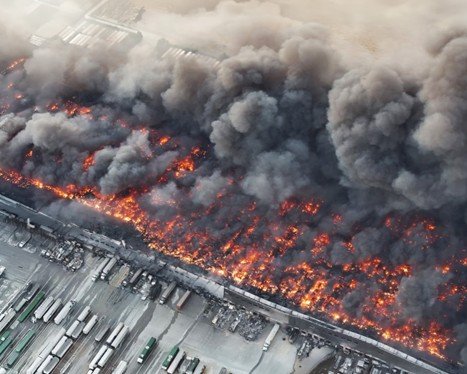 Tracy, CA medical warehouse fire sends plumes of black smoke into air.
Property Loss & Insurance Implications
The destruction of a modern distribution center creates property and business interruption exposures that can extend well beyond the building. Losses may include the structure, inventory, racking, lift equipment, automation systems, trucks, trailers, and critical logistics infrastructure. Medline later reported that product distribution from the Tracy facility had been reassigned to other regional facilities to support customer needs, underscoring the importance of supply chain contingency planning after a major warehouse fire.
For insurers and risk managers, the central lesson is fire protection reliability. NFPA 13 and 20 address the design and installation of automatic sprinkler systems and pumps, while NFPA 25 provides the baseline for inspection, testing, and maintenance of water-based fire protection systems. FM property loss prevention data sheets also provide engineering guidance intended to reduce property loss from fire and related equipment failures.
Key prevention measures include:
Verify fire pump system performance under realistic flow conditions.
Test private hydrants, yard mains, and sprinkler water supplies.
Confirm sprinkler design matches current commodities and storage heights.
Maintain supervised valves, alarms, and impairment procedures.
Coordinate pre-incident planning with responding fire departments.
Review business continuity plans for loss of a major distribution node.
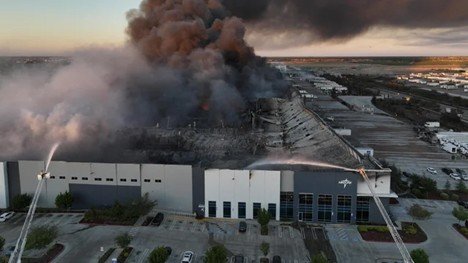 Tracy, CA warehouse fire impacts medical supply chain.
Risk Logic Perspective: Warehouse Fire Protection Reliability
Warehouse fire protection should be evaluated as an integrated system, not as separate equipment components. Sprinklers, pumps, tanks, underground mains, hydrants, valves, alarms, and monitoring systems must all function together during the early stages of a fire. A single point of failure can allow fire growth to exceed the capacity of both on-site protection and responding fire crews.
Facility owners should conduct routine fire protection inspections, water supply evaluations, valve supervision reviews, and impairment management audits. Risk managers should also reassess storage configurations whenever commodities, rack layouts, lithium-ion battery storage, automation systems, or packaging volumes change. These reviews help determine whether the installed sprinkler system remains appropriate for the actual occupancy.
Risk Logic engineers help facilities identify fire hazards, evaluate protection system reliability, and implement tailored loss prevention strategies. Contact Risk Logic to strengthen fire protection programs and reduce warehouse fire exposure.
Bottom Line: The Tracy, CA medical supply warehouse fire shows that large storage facilities depend on reliable sprinkler systems, fire pumps, and private water supplies to prevent a fire from becoming a total property and supply chain loss.