NFPA 855 (2026): Notable Changes to Stationary Battery Energy Storage Systems (BESS)
NFPA 855’s 2026 update strengthens explosion prevention, adds TRPP systems, and expands CCR requirements to improve lithium-ion BESS safety and loss prevention.
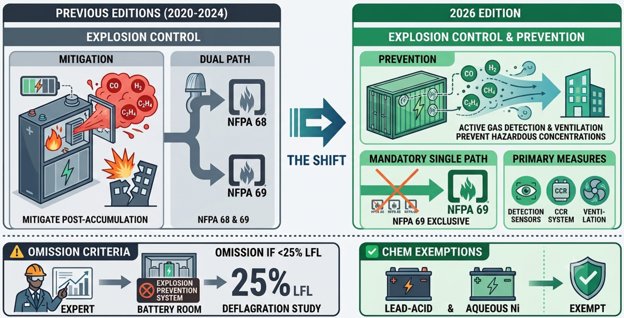 NFPA 855 Explosion Prevention Strategy Shift
Battery Energy Storage Systems (BESS) have become a critical component of modern electrical infrastructure, supporting renewable energy integration, grid stabilization, and backup power applications. As deployment of these systems has increased, so has the industry's understanding of the hazards associated with lithium-ion battery technologies, particularly thermal runaway, flammable gas generation, and explosion events.
Risk Logic has previously published several articles addressing lithium-ion battery energy storage system (BESS) hazards and loss prevention strategies. Most recently, our December 2024 article, Enhancing Lithium-Ion Battery Safety: Insights from FM Data Sheet 7-112, focused on FM's guidance and SFPE Engineering Solutions Symposium for managing thermal runaway, fire, and explosion hazards associated with lithium-ion battery installations.
This article shifts focus from FM guidance to NFPA 855, Standard for the Installation of Stationary Energy Storage Systems. Since its initial publication in 2020, NFPA 855 has undergone several revisions as the industry has gained additional testing data, operational experience, and insights from real-world incidents involving battery energy storage systems. The 2026 edition represents the third revision cycle of the standard and continues the industry's evolution toward improved management of thermal runaway, flammable gas generation, and explosion hazards.
While the 2026 edition includes numerous revisions, several changes stand out due to their potential impact on system design, explosion prevention strategies, commissioning requirements, and overall property loss prevention. The following is a brief overview of some of the more significant changes and their implications.
Feature / System |
Previous NFPA 855 Editions |
2026 Edition Requirements |
|---|---|---|
|
Explosion Strategy |
Focused on "Explosion Control;" permitted either NFPA 69 prevention or NFPA 68 deflagration venting. |
Shifts to "Explosion Control and Prevention;" exclusively requires NFPA 69 systems. |
|
Thermal Runaway |
Relied primarily on passive features like spacing, barriers, or compartmentalization. |
Introduces active Thermal Runaway Propagation Prevention (TRPP) systems. |
|
Gas Reduction |
Addressed via Combustible Gas Concentration Reduction Systems (CGCRS). |
Expanded into Combustible Concentration Reduction (CCR) systems with stricter performance rules. |
|
Battery Exemptions |
Treated all systems similarly regarding gas accumulation. |
Formally exempts lead-acid and aqueous nickel-based battery systems from these specific rules. |
Table 1 – Summary of Changes
Explosion Control and Prevention
One of the most notable changes in the 2026 edition is the transition from "Explosion Control" to "Explosion Control and Prevention." Earlier editions focused on mitigating the effects of an explosion after flammable gases had accumulated. The revised language places greater emphasis on preventing hazardous concentrations from developing in the first place.
Consistent with this shift, the 2026 edition removes NFPA 68 deflagration venting as a protection option and instead requires explosion control and prevention systems designed, installed, operated, maintained, and tested in accordance with NFPA 69.
The revised requirements also clarify the criteria under which explosion control and prevention systems may be omitted. Deflagration hazard studies must demonstrate that flammable gas concentrations will not accumulate and exceed 25 percent of the Lower Flammable Limit (LFL), on average, within the protected space.
In addition, the 2026 edition formally exempts lead-acid and aqueous nickel-based battery systems from explosion control and prevention requirements.
Thermal Runaway Propagation Prevention (TRPP) Systems
Perhaps the most proactive shift in the 2026 standard is the introduction of Thermal Runaway Propagation Prevention (TRPP) systems. TRPP is defined as an active means of mitigating thermal runaway propagation and represents a new approach to limiting the escalation of battery failures within an energy storage system.
The new section establishes requirements for mechanical, electrical, commissioning, inspection, testing, and performance validation aspects of TRPP systems.
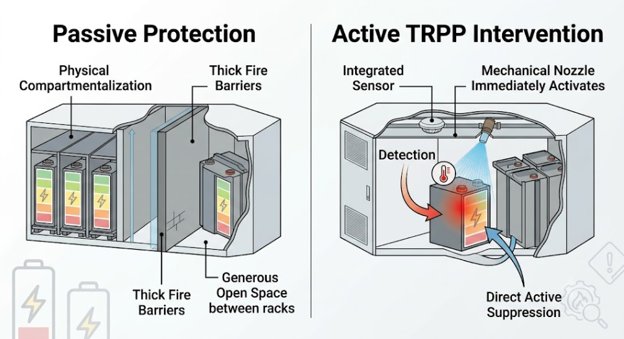 Passive Protection vs. Active Thermal Runaway Propagation Prevention (TRPP) Intervention
Combustible Concentration Reduction (CCR) Systems
The 2026 edition expands and refines the requirements for Combustible Concentration Reduction (CCR) systems. The revised requirements place greater emphasis on system performance, reliability, and verification.
CCR systems must be suitable for their intended use and capable of operating at temperatures expected during a thermal runaway event. Detection, control logic, and discharge sequences must not impede CCR system performance.
Where gas detection is used to initiate a CCR system, a listed continuous gas detection system must activate the CCR system at no more than 10 percent of the LFL. The CCR system must then remain operational to ensure flammable gases do not exceed 25 percent of the LFL on average.
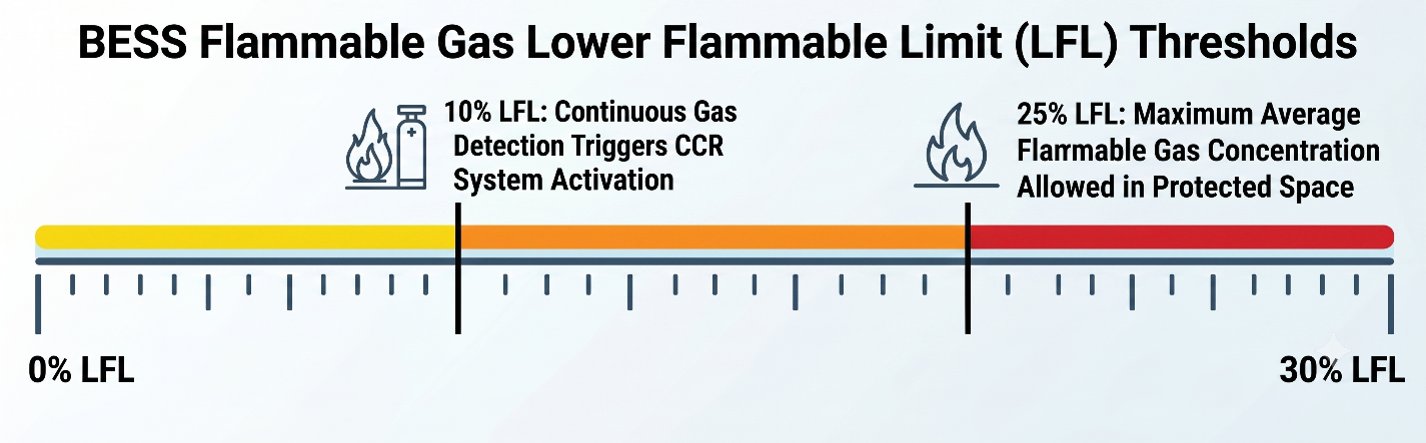 BESS Flammable Gas Lower Flammable Limit (LFL) Thresholds
Conclusion
The 2026 edition of NFPA 855 reflects the continued evolution of battery energy storage system safety. Key themes include preventing thermal runaway propagation, preventing hazardous gas accumulation, and enhancing expectations for performance and verification of critical safety systems.
The introduction of TRPP systems, expanded CCR requirements, and the shift toward explosion prevention demonstrate the industry's movement toward active prevention strategies supported by testing and engineering analysis.
Contact Risk Logic for a project review or onsite survey. Risk Logic has engineers located in over 35 countries and provides global risk control services.
Read more in: