Understanding Processes, Risks, and Hazards of the Mining Industry - Part 2
Part 2 of our four-part series explores how ore extraction, heavy machinery, autonomous systems, and geological conditions drive severe property loss and business interruption in the mining industry.
Part 2: Mining Methods and Property-Loss Hazards
By Larry Moore, PE, Risk Logic Inc.
Introduction
This is the second of a four-part series on mining property risk. Part 1 introduced the mining life cycle and the broad exposures of the industry. Part 2 focuses on the mine itself: how ore is extracted and transported, how geology and the selected mining method influence potential loss scenarios, and which safeguards are most important for limiting property damage and business interruption. Effective loss prevention therefore requires a site-specific evaluation by specialists familiar with the mining method and with applicable FM, NFPA, regulatory, and engineering guidance.
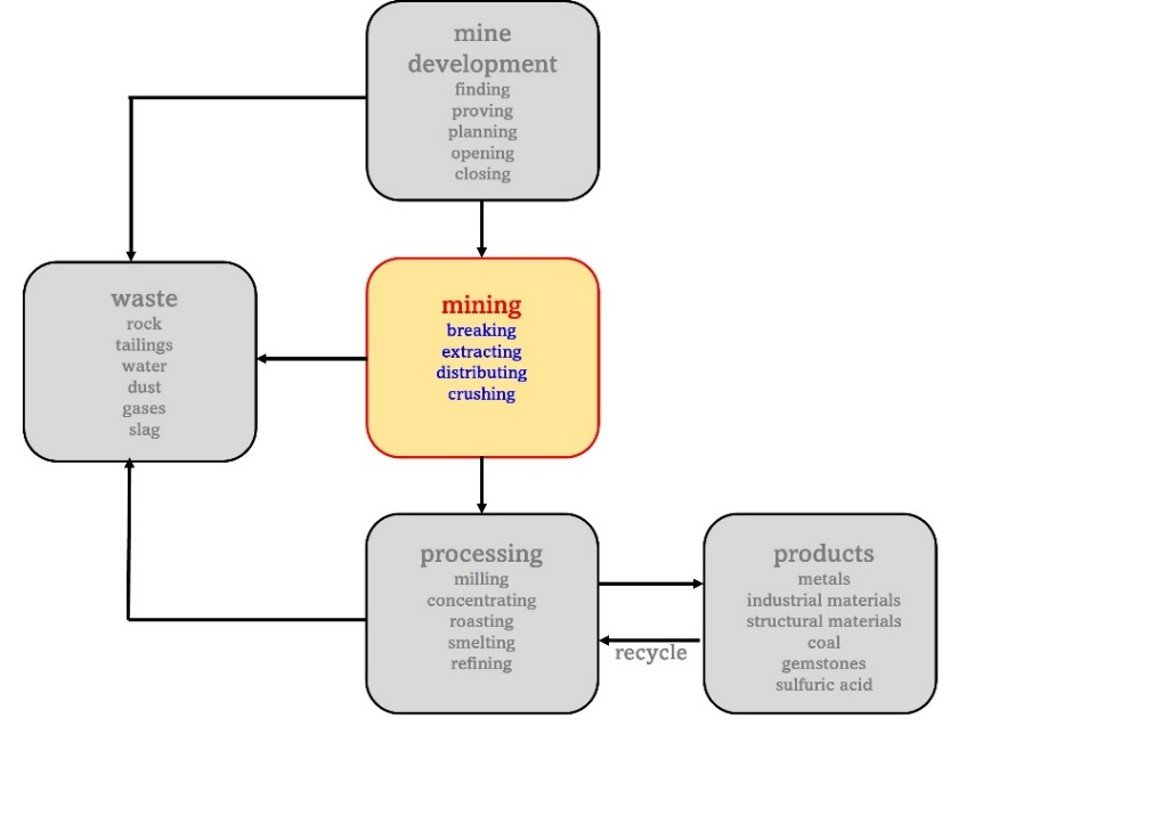 Where the mine fits in the mining life cycle. Sketch by author
What is a mine?
Mining is the extraction and recovery of economically valuable minerals from naturally occurring deposits. Mining is conducted underground, on the earth’s surface, under shallow bodies of water, and on the seabed floor. Potential future applications may include the extraction of mineral resources from asteroids or other extraterrestrial bodies.
The mining process involves breaking the desired material to release it from its geological formation; removing it from the mine; and transporting it to a downstream process such as crushing, milling, or concentration. Since mineral deposits vary widely in geometry, depth, grade, mineralogy, and rock strength, the methods used to break, extract, and transport the material also vary.
Surface mining is conducted in open pit, open cast, quarry, and strip mines. Surface mines are economically effective only when mineral deposits are on or near the surface; that is, where the waste rock overburden – called gangue - is relatively shallow or the material of interest is structurally unsuitable or economically impractical for underground mining. Open pit mining is often done in massive ore bodies called porphyries where the value is derived from processing a high volume of material.
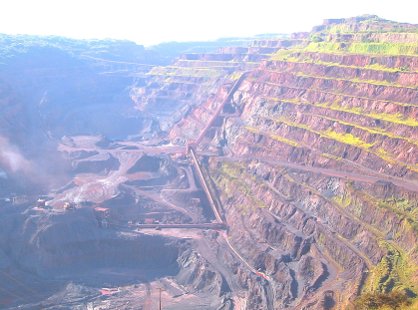 Open pit iron ore mine, Brazil, Amazon basin. Rather than using trucks, conveyors move the ore up the steep pit walls to the top where it is conveyed miles (km) to processing plants, railways, and finally to sea shipping ports. Photo by author
Underground mining is generally used when a deposit is too deep for economical surface extraction, occurs in relatively narrow high-grade veins, or forms a deep layered deposit such as coal, salt, or potash. Underground operations are more complex and costly than surface mines because they require ground support, ventilation, dewatering, emergency egress, and systems for transporting personnel, equipment, and ore through constrained underground openings.
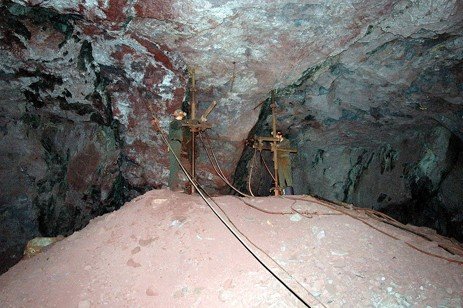 Stope mining in underground hard rock mine using drilling and blasting to free the ore. Photo by author
Titanium, zirconium, diamonds, and gold are often found in beach sand (rutiles) or placers. A common mining method for these deposits are floating dredges on man-made ponds. Extraction is by pipe or conveyor to a processing plant on the dredge or on the shore.
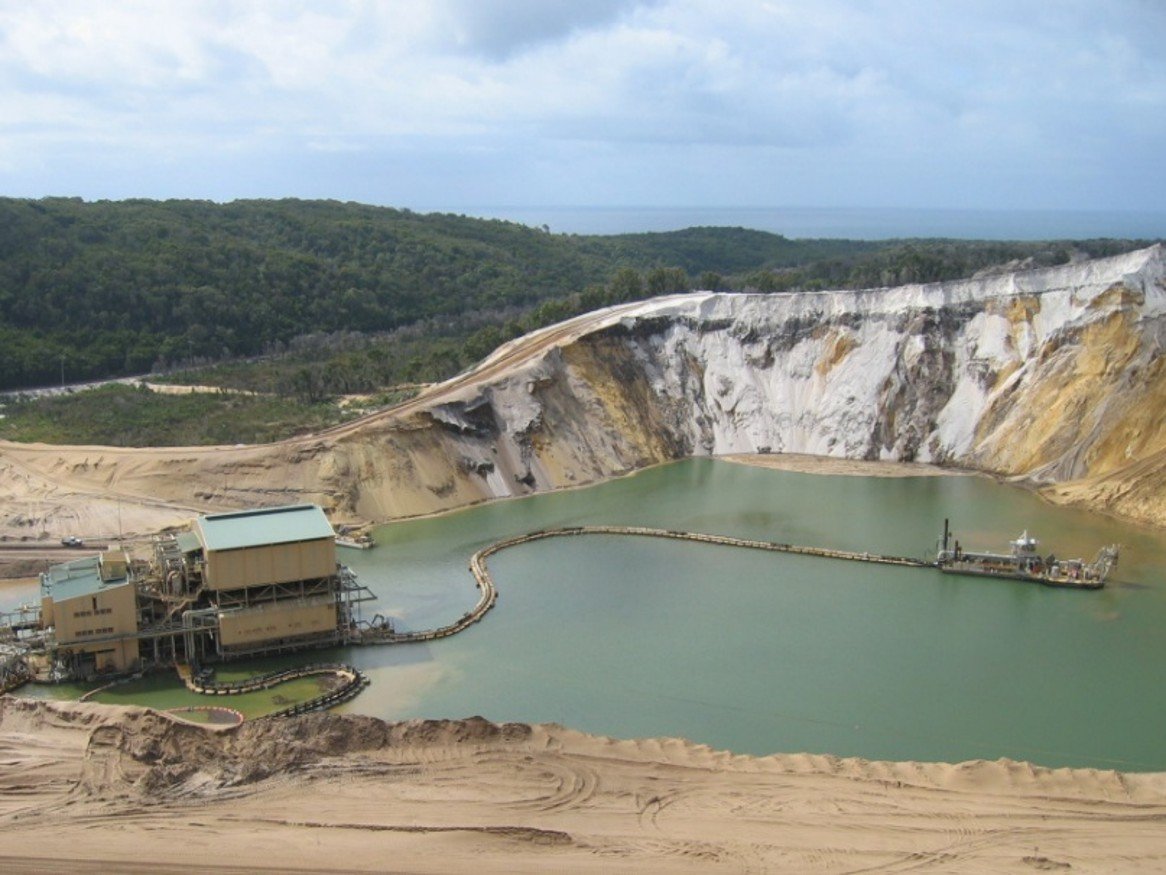 Titanium sands mining dredge, Australia. Rutile sand is suctioned by a floating snorkel and conveyed by pipeline to a floating concentrator. Photo by author
For underground coal and other soft deposits like potash, large walking grinding machines called longwalls or mobile mining machines use cutting wheels to break and remove the material. These form pillars which support the roof.
|
|
|
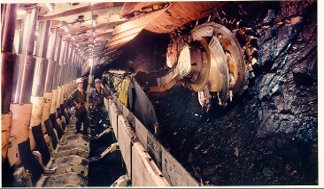 Longwall mining machine in coal mine.
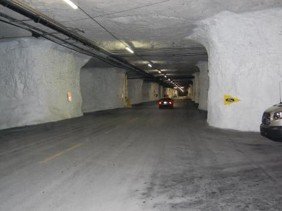 Underground soft rock room and pillar mine using mobile grinding machines to break the ore.
In hard-rock mines, drilling and blasting are commonly used to fragment the rock. Depending on the mine layout, ore may be transported to a crusher or processing plant by haul truck, hoist, conveyor, rail, aerial tramway, or pipeline. The reliability of these systems is critical because the failure of a single shaft, hoist, crusher, conveyor, or access route can interrupt the entire operation.
Mining Property Risk and Hazards
The primary mining property risks are in mines are:
fires and explosions
mechanical breakdown
operational technology and cyber risk
hydrogeological inundation (flooding)
geotechnical (earth movement)
environmental
geopolitical
Fires and explosions
Coal mines generally present greater fire and explosion risk than hard rock mining because the ore is both combustible and explosive. The unique risks of underground coal mines include explosive gases, combustible coal dust, and spontaneous combustion, notably in deep-seated seams in abandoned areas, called gobs.
Common fire hazards at both surface and underground mines include combustible conveyor belts; lubricating-oil and hydraulic-fluid systems; oil-filled transformers; fueled mobile equipment and large rubber tires; grouped electrical cables; plastic ventilation materials; combustible maintenance supplies; and accumulations of waste or discarded materials. Timber ground support, although less common in modern operations, can contribute substantially to fire development and smoke production where it remains in use.
The most notable underground US fire in a non-coal mine occurred in the Sunshine Mine, Wallace Idaho, May 2, 1972*. The silver mine was 6,000 feet (1828 m) below the surface and contained miles (km) of active and inactive drifts with wood timber sets for ground control and plastic or foam insulation and ventilation seals.
The fire started by spontaneous combustion in oily rags in an abandoned drift. There were extensive wood timber sets and combustible discarded debris such as rubber tires.
|
|
|
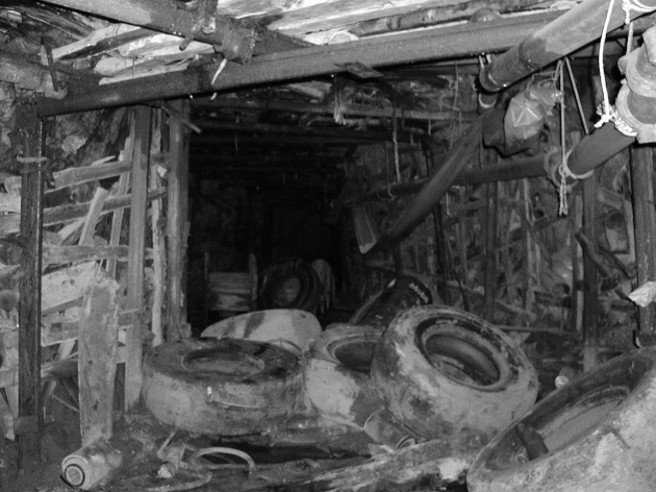 Discarded debris and wood timber sets.
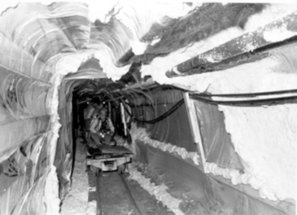 Plastic ventilation curtains
The fire resulted in 91 fatalities, and the mine was closed for 7 months. The loss precipitated the formation of the Mine Safety and Health Administration (MSHA), which caused major changes to hard rock mine regulations.
*US Bureau of Mines (USBM) Final Report of Major Mine Fire Disaster, Sunshine Mine, Sunshine Mining Company, Kellogg, Idaho, May 2, 1972 , Stanley M. Jarrett et al, Feb 14, 1973
Protection against fires in mines includes emergency response training; ventilation control; localized automatic sprinklers for rubber conveyors, crusher lube oils systems, or equipment shops; special suppression systems for mobile equipment engine compartments; and minimizing, isolating, or eliminating combustible waste, rubber, plastic, and wood.
Protection against dust explosions in underground coal mines is a highly specialized science including control of ventilation and ignition sources; use of wetting agents at cutting wheels; and application of non-combustible coatings like limestone. Coatings are sprayed on underground tunnel walls and roofs to mix with coal dust, if disturbed into the air, in an inerting process called phlegmatization. The inert mixture renders the coal dust less or non-explosive.
Mechanical breakdown
Mechanical and electrical breakdown is a leading loss driver in the mining industry.
The mining industry uses the largest equipment in the world under exceptionally demanding and harsh conditions. Examples include haul trucks with capacities approaching 400 short tons (360 tonnes), large electric shovels and draglines, high-capacity hoists, and motors that drive miles (km) long conveyor systems. Major components may have replacement lead times measured in months or years, and some equipment must be assembled or repaired on site.
Exacerbating this is the harsh environment, including vibrations from blasting, high moisture, standing water and mud, heat, diesel fumes, abrasive dust, and heavy loads, which can shorten life, contaminate oil lubrication systems, and reduce intervals between maintenance and inspections.
|
|
|
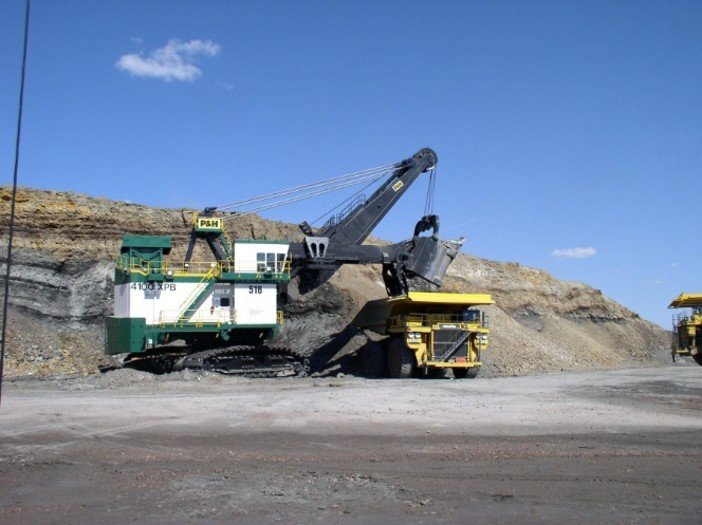 Electric shovel loading haul truck.
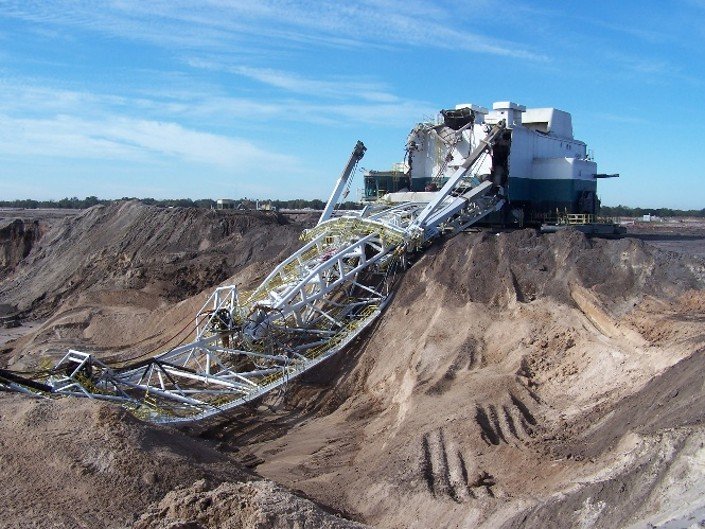 Collapse of “A Frame” boom on dragline at coal mine.
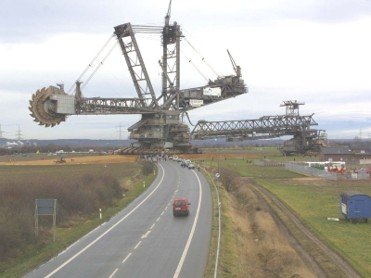 The world’s largest coal excavator, Germany, being moved across a highway. The value of this mining machine is estimated to be around $100 million and it took 5 years to manufacture and assemble. Photo from internet.
Ore removal and transport systems frequently contain single points of failure. Mine hoists use wire ropes and specialized large motors to raise and lower personnel, equipment, and ore into deep shafts. Failure of a rope, drum, brake, control system, or supporting structure can damage the shaft and interrupt access to the mine for an extended period.
Slurry pipelines with ore in solution may be used when the mine is remote from a port. For example, at one mine in Chile, a copper ore slurry pipeline drops 15,000 feet (4500 m) from the mine to sea level where the slurry is dewatered and concentrated. Slurry pipelines are subject to extreme elevation change pressure and have ruptured, causing business interruption and environmental damage.
Routine predictive and preventative maintenance at a frequency according to manufacturer’s specifications, and at an increased frequency based on local (harsher) conditions, are the primary protection against mechanical and electrical failure in mining equipment. For ultra-large equipment with long booms under stress, such as draglines and bucket excavators, nondestructive examinations (NDE) and finite element analysis (FEA) are needed. Slurry pipelines require sophisticated pressure relief systems and frequent inspections.
Operational-Technology and Cyber Risk
Mine operators increasingly use autonomous haulage, remote equipment operation, fleet-management platforms, positioning systems, wireless communications, and centralized control systems. These technologies can improve safety, consistency, productivity, and equipment utilization. They can also create operational concentration of risk when a common network or control platform supports a large portion of production.
A failure or compromise affecting fleet dispatch, positioning, communications, industrial controls, or remote access may stop multiple units simultaneously. The resulting interruption can be especially severe when autonomous equipment lacks an operator cab or when trained personnel are not available to operate the fleet manually. Cyber events may also impair protective functions, corrupt operational information, or delay a safe and orderly shutdown.
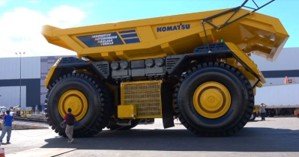 Fully autonomous self-driving unmanned 186-ton haul truck. Note lack of operator cab. Photo courtesy of Komatsu.
Controls should include an accurate inventory of operational-technology assets; appropriate separation of information-technology and operational-technology networks; controlled and monitored remote access; least-privilege access; secure configuration and patch-management programs; protected backups; vendor-access controls; and incident-response and recovery plans. Operators should also identify safe equipment states and test the ability to maintain or restore critical production following the loss of a control network, communications system, or fleet-management platform.
FM Property Loss Prevention Data Sheet 7-110, Industrial Control Systems, provides guidance for assessing industrial-control and cyber hazards from a property-protection and business-continuity perspective.
Hydrogeological inundation (flooding)
Many underground mines operate below the groundwater table and depend continuously on dewatering systems. Other mines may encounter unknown water-bearing formations, flooded historical workings, or high-pressure aquifers. Surface mines may be exposed to heavy rainfall, runoff, overflowing rivers, dam failures, or the loss of drainage routes. Some shaft-sinking projects use ground-freezing systems, grouting, or watertight shaft linings to control water while excavations pass through saturated formations.
Loss of pumps, electrical power, ground-freezing equipment, barriers, drainage systems, or monitoring can allow water to enter a mine. Inundation may also result from accidental penetration of a water-bearing formation or flooded historical workings, failure of a barrier or bulkhead, extreme surface runoff, or subsidence beneath a lake or river. Water entry may occur too quickly to remove mobile equipment. Even if dewatering is technically possible, damage to underground openings, electrical equipment, ore stability, and water quality can make recovery uneconomical.
|
|
|
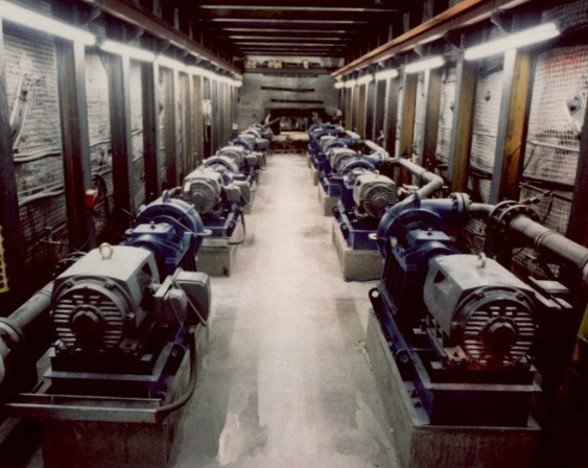 Dewatering pumping station in underground silver mine removed over 10,000 gpm (38,000 l/min) water inflow.
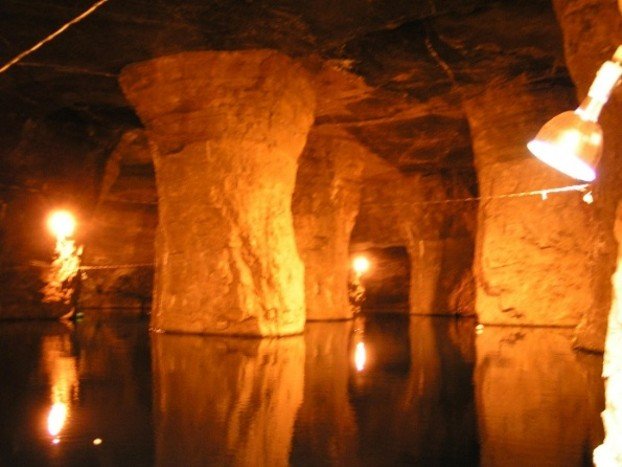 Water in underground room and pillar potash mine. Water can slowly dissolve salts and make pillars less stable.
|
|
|
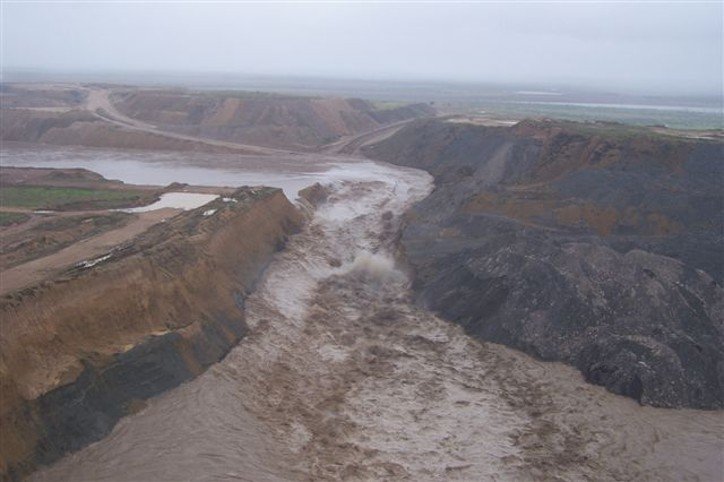 Inundation of a Queensland, Australia surface coal mine after heavy rain collapsed an upstream dam, 2008.
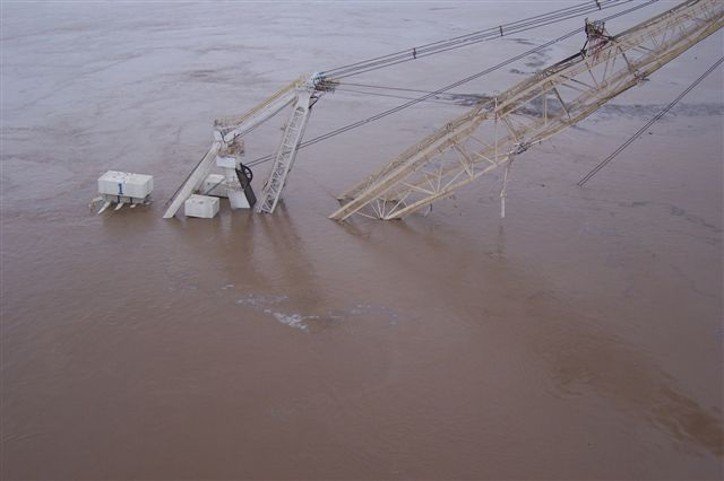 Flooded dragline.
Prevention of mine flooding is critical to continued and safe operations. Of primary importance is an up-to-date hydrogeological inundation assessment of the mine to ensure exposures from bodies of water are identified, well understood and managed.
Dewatering pumps must have redundancy and auxiliary power should a critical pump fail, or if a power outage occurs. Hidden water bodies need to be identified and mapped by sonar or by predrilling exploratory holes. Water entry from the surface can be controlled by proper mine design, river channeling, and other measures. Underground flooding might be minimized by manually closing water barriers as part of an inundation emergency response plan.
Geotechnical (earth movement)
Underground mines are susceptible to geotechnical failures such as roof falls, rockfalls, rock bursts, pillar failures, floor heave, and subsidence. These events may result from severe gravitational forces especially ion very deep mines, excessive stress, inadequate ground-support design, changes in mining sequence, blasting, seismic activity, groundwater, or failure to recognize faults and other geological structures. Ground-control systems must account for rock strength, in-situ stress, excavation geometry, mining sequence, and changing conditions over the life of the mine.
Earth movement can be localized involving a small mass of rock falling onto a single piece of equipment or blocking a drift; it can be of moderate consequence such as a rock burst which ejects material from a side wall (rib) with enough force to produce an air blast; or it can be widespread and catastrophic in the case of a cascading pillar failure resulting in collapse of several square miles and permanent loss of the mine. Coal and salt mines can experience heave and creep whereby excessive gravitational forces cause the floor and roof to compress into each other, gradually closing the opening.
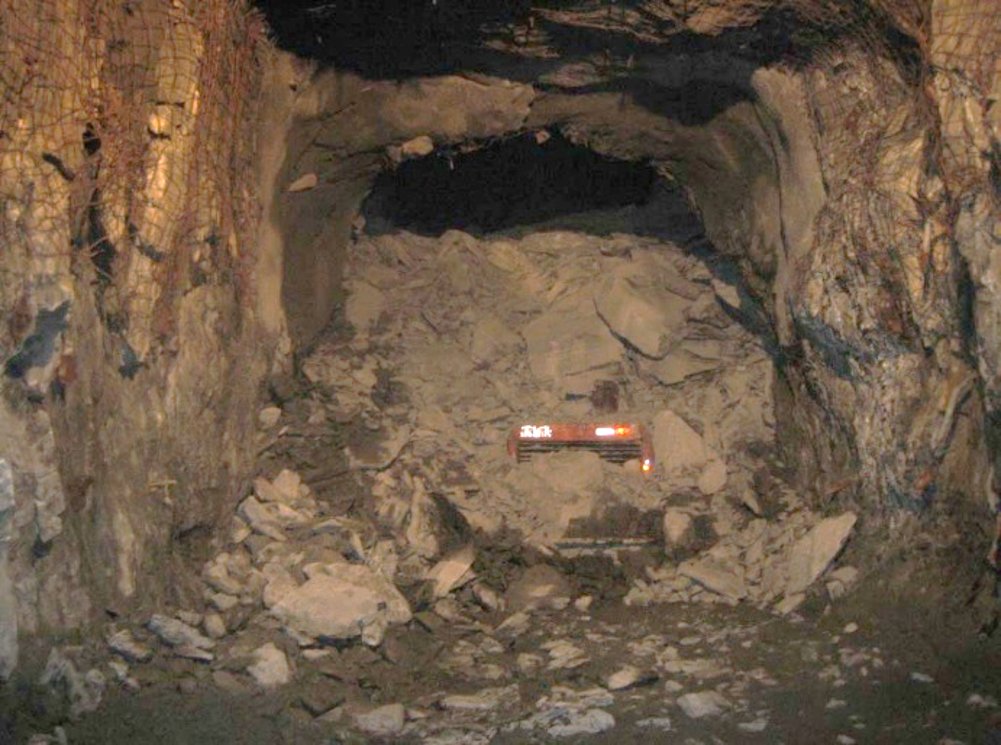 Localized roof fall on mobile equipment in underground mine. Photo by author
Surface mines are susceptible to slope wall failure. Because it generally costs the same to remove waste rock as ore, operators keep slopes as steep as safely possible to avoid moving excess material without causing a sudden failure. A major failure may bury equipment, damage roads and utilities, isolate portions of the pit, or interrupt production for months.
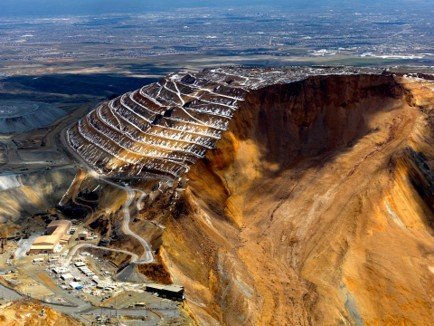 Massive slope wall failure of 145 million tons of rock at the Bingham Canyon Mine, Rio Tinto, Utah, 2013, damaged or destroyed dozens of haul trucks, cut a maintenance complex in half, and shut down operations for months. Photo from Internet.
Conducting geotechnical risk assessments; implementing an underground ground control management plan; developing an open pit slope wall stability plan; using established safe mining and blasting practices; using movement detection sensors; and conducting inspections are the best protection options to minimize potential for earth movement in mines. Defined trigger-action-response plans should specify the thresholds that require increased monitoring, restricted access, evacuation, or other corrective action.
Environmental exposures
Environmental impacts such as acid water drainage; nuisance dust generation; abandoned open pits full of water; waste rock piles; cyanide or acid leakage from leaching processes; exposure from an upstream tailing disposal facility: and methane gas leakage can present threats to a mine operation and to the environment. There are many legacy mining sites with environmental damage which can last for decades, and this influences public perception and acceptance of the industry.
Geopolitical exposures
Mining may not be accepted or tolerated due to a myriad of reasons including noise, visual and environmental impact. There are many examples of strained relations with local populations, especially in developing countries. Mines producing high-value commodities such as gold or diamonds may also require enhanced controls for theft, armed intrusion, and product security.
A notable civil action against a mining operation is the Panguna copper mine, at the time owned and operated by an Australian mining company and located on the Island of Bougainville, Papua New Guinea. Due primarily to environmental contamination of a local river system, an uprising and takeover of the mine occurred in 1988 by a militant political group. This caused the closure of the mine and withdrawal of personnel. As of 2026, almost 40 years later, the mine remains closed, although the rich copper ore remains in the ground.
Key Takeaways
Mine risk is shaped by the interaction of geology, mining method, equipment, water, energy, control systems, and human factors. A severe fire, critical-equipment breakdown, inundation, ground failure, or control-system outage can damage difficult-to-replace assets and interrupt production for months or years.
Effective risk evaluations should:
identify credible property-damage and business-interruption scenarios
determine whether critical systems contain single points of failure
evaluate the capacity, independence, and reliability of protective systems
consider equipment lead times, strategic spares, access, and repair capability
confirm that monitoring and emergency plans include defined action thresholds
establish how critical production can be maintained or restored following a major loss
Risk Logic can help mine operators and insurers evaluate these exposures and develop practical property-protection, mechanical-integrity, maintenance, and business-continuity improvements. Please contact Risk Logic to discuss a property-risk survey by one of our mining specialists.
For additional loss prevention and protection advice for the mining industry refer to the following standards:
Our Services
Risk Logic can help mine operators and insurers evaluate these exposures and develop practical property-protection, mechanical-integrity, maintenance, and business-continuity improvements. Please contact us to discuss a property-risk survey by one of our mining specialists.
Resources
For additional loss prevention and protection advice for the mining industry, refer to the following standards:
-
FM Loss Prevention Data Sheet 7-12, Mining and Mineral Processing
-
FM Loss Prevention Data Sheet 7-40 Heavy Duty Mobile Equipment
-
FM Property Loss Prevention Data Sheet 7-110, Industrial Control Systems
-
NFPA 120, Standard for Fire Prevention and Control in Coal Mines
-
NFPA 121, Standard on Fire Protection for Self-Propelled and Mobile Surface Mining Equipment
-
NFPA Fire Protection Handbook, 20th Edition, Chapter 16, Mining and Mineral Processing, L. Moore, 2008
U.S. Mine Safety and Health Administration (MSHA), Title 30, Code of Federal Regulations, Parts 1–199. Mineral Resources.
About the author
Larry Moore, PE, spent over 50 years conducting fire and explosion risk surveys, hazard assessments, loss investigations and geotechnical studies in the mining and related industries while working for Factory Mutual Engineering and Research and FM Global (now FM). He visited over 2500 industrial sites including an estimated 400 mines and mineral and metal processing facilities in over 70 countries during his career. He developed mine and other industry fire protection standards for FM, the National Fire Protection Association (NFPA) and the American Institute of Chemical Engineers (AIChE) and was chair of the NFPA mining facilities standards committee for ten years. He has made numerous presentations and published technical papers on processes and risks of the mining and chemical industries. When he retired from FM, he was corporate Staff Vice President and Principal Engineer for the mining and metallurgical refining industries. He is an elected Fellow of AIChE, a member of the Society of Mining Engineers and is a registered professional engineer in Fire Protection Engineering, Commonwealth of Massachusetts. He now consults for Risk Logic Inc., specializing in the chemical, metallurgical and mining industries, and resides in Colorado.
Read more in: