Tears Over the Towers: Reflecting on 25 Years Since 9/11
Reflecting on 25 years since September 11, we examine the structural design, building code evolutions, and engineering lessons learned from the original World Trade Center towers to One World Trade Center.
Tears Over the Towers
“Reflecting on 25 years since 9/11”
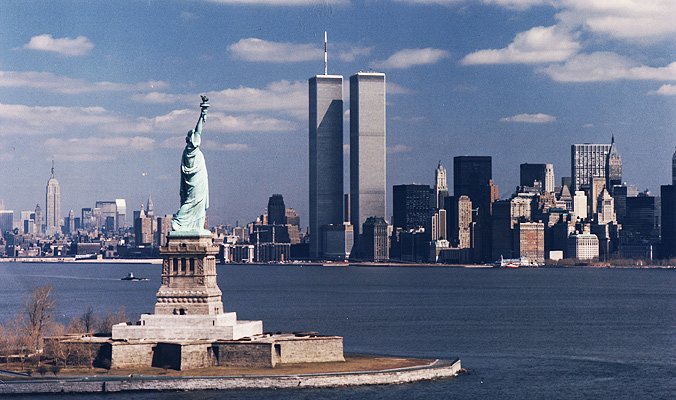
The World Trade Center (WTC), or Twin Towers 1 & 2, was iconic. They shaped downtown NYC. Their beauty was undeniable. At the top of WTC 1, a restaurant called “Windows on the World” rotated constantly, showcasing one of the most amazing views in the World. At the top of Tower 2 was “The Greatest Bar on Earth.” A beautiful place to unwind, have a drink, and soak in the view.
Over time, more prestigious companies moved into the Towers. Aon moved into Tower 2 in the mid-90s and occupied the top floors. Marsh moved in shortly thereafter and was the second-highest tenant in Tower 1, with Cantor Fitzgerald just above.
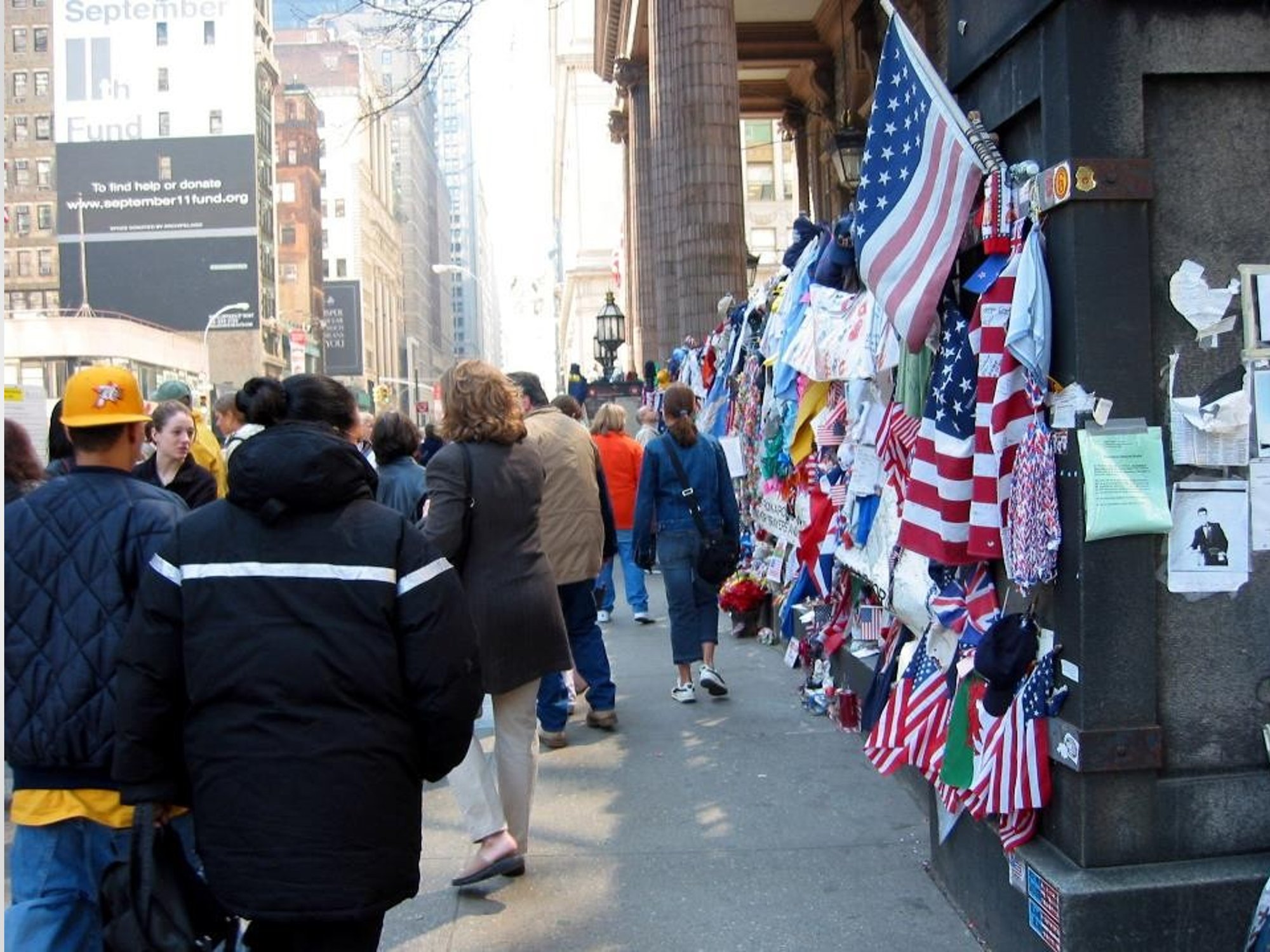
The tragedy that took place 25 years ago on September 11th carries a heavy, painful burden on so many. September 11th will always be a sad day and a day of prayer and mourning for lost loved ones.
On and shortly after 9/11, the greatest city in the world, NYC, responded heroically with so many brave firefighters, police, and emergency service personnel. It was an eerie feeling after 9/11. No one could understand why so many innocent people lost their lives. It was painful for so many.
Let’s look back in time:
1945
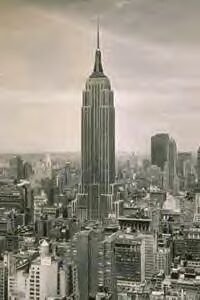
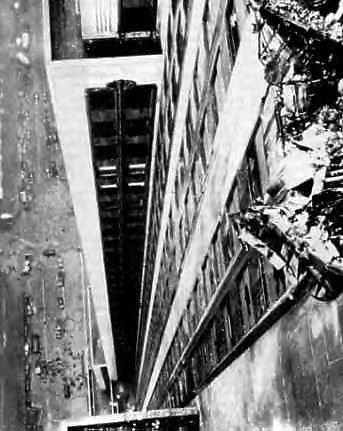
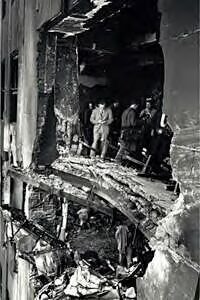
On July 28, 1945, a US Army B-25 bomber weighing approximately 20,000 lb. and traveling 275 mph struck the Empire State Building.
This is an important fact because the architects and engineers hired by the Port Authority claimed that when the initial World Trade Center design was finalized, it could withstand the force of a Boeing 707, the largest commercial airliner at the time the building was erected in 1972.
The 707 had a takeoff weight of 258,000 lb., cruised at 615 mph, and was 130 ft. x 145 ft.
The 767 (which struck the WTCs) had a takeoff weight of 312,000 lb., cruised at 550 mph, and was 156 ft. x 159 ft.
Below you can see the superior reinforced concrete construction of the Empire State Building and the minimal damage that occurred when the bomber struck it.
World Trade Center Design Facts
In 1972, the WTC was completed.
110 stories high – 1,368 ft., ¼ mile, or 4.5 football fields in height.
The WTC did not have to conform to the NYC Building Code; it had to conform only to the Port Authority Code.
Several building officials have been on record saying that if the building had to conform to the NYC Building Code and not the Port Authority Code, it would not have been built because of the excessive cost.
NYC Building Code includes Local Law 5, which says automatic sprinklers can be omitted in a building if an area has 2-hour fire-rated walls and is compartmentalized in 7,500 sq. ft. sections.
When the WTC was built, it was an open, landscaped office with each floor being one acre and was not protected by automatic sprinklers when originally constructed. Sprinklers were retrofitted after a fire in the 70’s.
The construction of the WTC had steel framing protected by cementitious fireproofing versus reinforced concrete. (See Empire State Building photos.)
The WTC was designed to sway 15 – 25 ft., and they pumped white noise into the building, especially on windy days, so you could not hear the creaking.
The building movement caused a significant amount of fireproofing on the steel beams to dislodge.
Each floor on the Trade Center was a metal shell with 4 inches of poured concrete per floor supported by 59 tubular metal columns on each side. Each tube had four bolts at the upper stories and six bolts at the lower stories, connecting to the metal pan holding the poured concrete. The bolts were not fireproofed. The outer shell was a structural support, and the nearest structural support was inside the building by the core, which contained the elevators and stairwells.
In 1970, the real estate lobbyists were able to remove a small yet significant part of the building code, which stated that all walls within a stairwell had to withstand 150 psi, or the pressure from a hose stream from a firefighter. This was removed, and at that time, exterior stairwell walls began to be constructed with two layers of 5/8-inch gypsum board and metal studs. Gone were stairwells with concrete block walls like those in the Empire State Building and other older buildings.
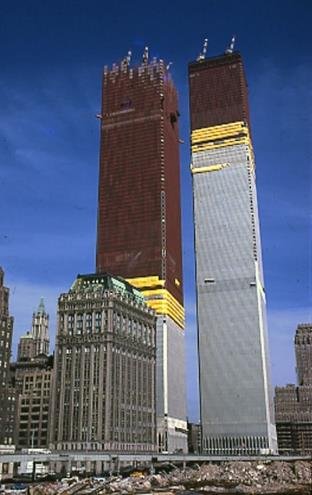
Twin Towers Construction
Twin Towers at different stages of construction. The tower on the left has about 1/3 of the structure clad in aluminum. Four-fifths of the steel structure on the right is clad in aluminum.
September 11, 2001
There were three main reasons fewer people were in the WTC on September 11, 2001.
The NY Giants lost to the Denver Broncos on Monday Night Football the night before, and the game ended past midnight; many people who watched the game got up late Tuesday morning.
It was the first day of school in NYC, so many parents were taking their children to school.
It was the Democratic primary election, and people were out voting.
Timeline
Early Morning Context
6:00 a.m. – Polls open in New York City for the primary elections.
7:59 a.m. – American Airlines Flight 11 takes off from Boston for Los Angeles.
8:00 a.m. – New York City public schools open for the first day of the new school year.
8:14 a.m. – United Airlines Flight 175 takes off from Boston to Los Angeles.
8:20 a.m. – American Airlines Flight 77 takes off from Washington, DC, for Los Angeles.
8:42 a.m. – United Airlines Flight 93 departs 42 minutes late from Newark for San Francisco.
8:46 a.m. – After receiving a call from the Federal Aviation Administration’s Boston control center that Flight 11 has been hijacked, the Northeast Air Defense Sector (NEADS) scrambled two military jets to the New York area from Otis Air National Guard Base, Cape Cod.
8:46 a.m. – Hijackers crash American Airlines Flight 11 into floors 94 to 98 of 1 World Trade Center, the North Tower.
8:46 a.m. – The Fire Department of New York (FDNY) receives the first report of a plane crash into the North Tower. Evacuation in the North and South Towers begins.
9:00 a.m. – FDNY, the New York Police Department (NYPD), and the Port Authority Police Department (PAPD) are at their highest mobilization levels. Port Authority civilian staff and all on-duty WTC response staff have mobilized.
9:03 a.m. – Hijackers crash United Airlines Flight 175 into floors 78 to 84 of 2 World Trade Center, the South Tower.
9:15 a.m. – Officials begin closing New York City bridges and tunnels to all but emergency vehicles and pedestrians.
9:25 a.m. – The Federal Aviation Administration orders the first-ever nationwide ground-stop, prohibiting the takeoff of flights. Northeast Air Defense Sector (NEADS) jets established combat air patrol over Manhattan.
9:30 a.m. – The New York Stock Exchange does not open; its employees evacuate.
9:37 a.m. – Hijackers crash American Airlines Flight 77 into the Pentagon.
Broader National Response
9:40 a.m. – The Federal Aviation Administration orders all 4,546 planes in North American airspace to land at the nearest airport.
9:45 a.m. – Evacuations are under way at the United States Capitol, the White House, the Empire State Building, the United Nations, the Kennedy Space Center, Disney World, and major sites across the United States.
9:59 a.m. – 2 WTC, the South Tower, collapses in 9 seconds.
10:03 a.m. – Hijackers crashed United Airlines Flight 93 in a field in Shanksville, Pennsylvania, after passengers launched a counterattack to seize control of the aircraft.
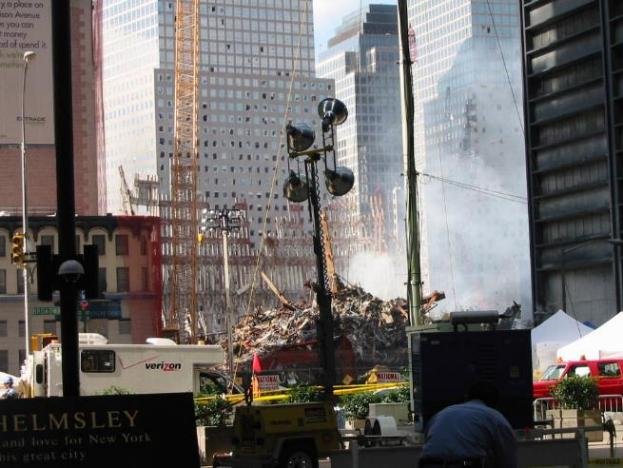
10:28 a.m. – 1 WTC, the North Tower, collapses in 11 seconds. All sixteen acres of the World Trade Center site are in ruins. A rescue and recovery effort begins immediately.
Collapse and Emergency Declarations
10:30 a.m. – New York Governor George E. Pataki declares a state of emergency in New York.
11:02 a.m. – New York City Mayor Rudolph Giuliani orders the evacuation of all Lower Manhattan below Canal Street.
1:27 p.m. – A state of emergency is declared in Washington, DC.
2:35 p.m. – Mayor Giuliani holds a press conference at the New York City Police Academy, estimating that "the number of casualties will be more than any of us can bear."
5:20 p.m. – 7 World Trade Center collapses.
8:30 p.m. – President George W. Bush addresses the nation, saying: "Today, our nation saw evil, the very worst of human nature. And we responded with the best of America—with the daring of our rescue workers, with the caring for strangers and neighbors who came to give blood and help in any way they could.”
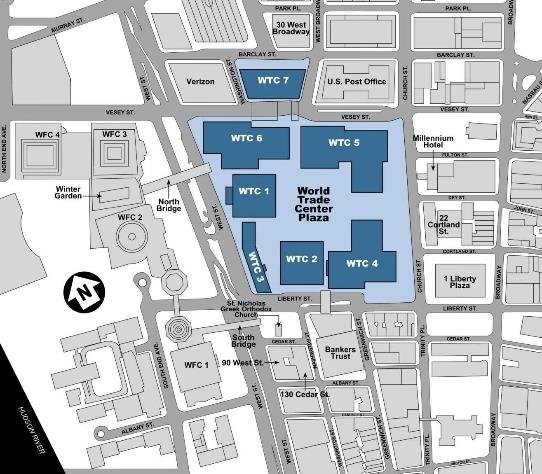
Understanding What Happened
No one could have ever imagined commercial airlines being used as weapons. After planes struck the WTC, the collapse of the WTC was inevitable.
WTC 1 had a direct impact on floors 94–98, and it took 102 minutes to collapse.
WTC 2 had a direct impact on floors 78–84, and it took 56 minutes to collapse.
The buildings collapsed too quickly. More people could have survived. People needed more time to escape.
The initial design stated the building could withstand a 707 striking the WTC. When the building was designed in the 1960s, what factual information could that have been based upon?
The National Institute of Standards and Technology (NIST) has gone on record to say Port Authority could not have had a Boeing 707 aircraft analyzed during the World Trade Center design stage. NIST investigators were unable to locate any documentation of the criteria and method used in the impact analysis and, therefore, were unable to verify the assertion that “…such collision would result in only local damage which could not cause collapse or substantial damage to the building.…”
The capability to conduct rigorous simulations of the aircraft impact, the growth and spread of the ensuing fires, and the effects of fires on the structure is a recent development. Since the approach to structural modeling was developed for the NIST WTC investigation, the technical capability available to the Port Authority of NY and NJ (PANYNJ) and its consultants and contractors to perform such analyses in the 1960s would have been quite limited compared with the capabilities brought to bear in the NIST investigation shortly after 9/11.
Based on its comprehensive investigation, NIST concluded that the WTC towers collapsed because:
(1) the impact of the planes severed and damaged support columns, dislodged fireproofing insulation coating the steel floor trusses and steel columns, and widely dispersed jet fuel over multiple floors; and
(2) the subsequent unusual excessive amount of jet fuel ignited multi-floor fires (which reached temperatures as high as 1,000 degrees Celsius, or 1,800 degrees Fahrenheit), significantly weakened the floors and columns with dislodged fireproofing to the point where floors sagged and pulled inward on the perimeter columns. This led to inward bowing of the perimeter columns and to the failure of the south face of WTC 1 and the east face of WTC 2, initiating the collapse of each tower.
Likely because of cost, the Port Authority was mysteriously able to change the local code before construction, so the WTC stairwells were not built from concrete block but from gypsum board, a significantly weaker material.
Insurance Losses
9/11 losses
$61.28B in 2026 dollars ($32.5B in 2001 dollars)
Property – WTC $6.6B
Property Other – $11.1B
BI – $20.25B (~33%)
Aviation Liability – $6.5B
Aviation Hull – $0.9B
Workers Comp – $3.3B
Event Cancellation – $1.8B
Other Liability – $7.4B
Life – $1.8B
Was it one incident or two?
Developer Larry Silverstein originally held a $3.55B property policy. He argued in court that the two plane strikes constituted two separate insurance events, which would entitle him to double the payout.
Following years of intense litigation, the courts split the difference based on varying policy language, resulting in a final landmark $4.55B in 2007 to rebuild the World Trade Center site.
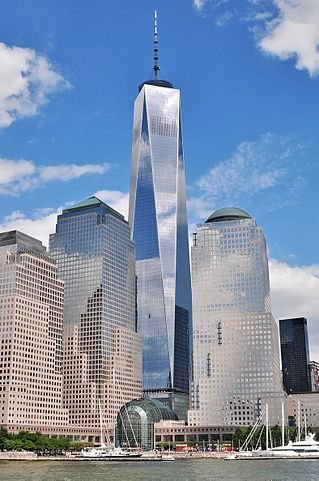
One WTC Freedom Tower
Opened November 3, 2014
1,776 ft. in height
104 floors + 5 subfloors
3.5M sq. ft.
Construction Cost = $3.9B
Reinforced concrete base
3 ft. thick reinforced concrete walls in all stairwells, elevator shafts, risers, and rooms with sprinkler risers and standpipes
There are also extra-wide, pressurized stairwells, along with a dedicated set of stairwells exclusively for the use of firefighters.
In comparison, the original Twin Towers used a purely steel central core to house utility functions, protected only by lightweight drywall panels.
Summary
In summary, the World Trade Center, under the original World Trade Center design and Port Authority standards had significant limitations. The catastrophe of 9/11 exposed gaps not just in the WTC's design and implementation, but in global building and fire codes, which had never anticipated the structural load of fully fueled commercial airliner impacts and subsequent infernos.
The poor stairway configuration, lightweight floor trusses, and the highly susceptible fireproofing insulation were negative factors. Eventually, this led to the revamping of the building codes, notably the International Building Code (IBC), which is evident in the design of the Freedom Tower.
Prayers for everyone who passed away on or because of 9/11.
References
The National Institute of Standards and Technology (NIST) is an agency of the U.S. Department of Commerce
Photos